Surnames Law (選択的夫婦別姓)
Respondents were randomly assigned to read a short passage framing the surnames issue from one of eight angles — human rights, constitutionality, social benefits, social disadvantages, international norms, national pride, or tradition (supportive or opposing) — or a neutral control condition. They then rated their support for allowing married couples to keep separate surnames on a five-point scale. Results are reported as average treatment effects (ATEs) relative to the control group, estimated via OLS with HC2 standard errors.
Wave 2022 November
Results
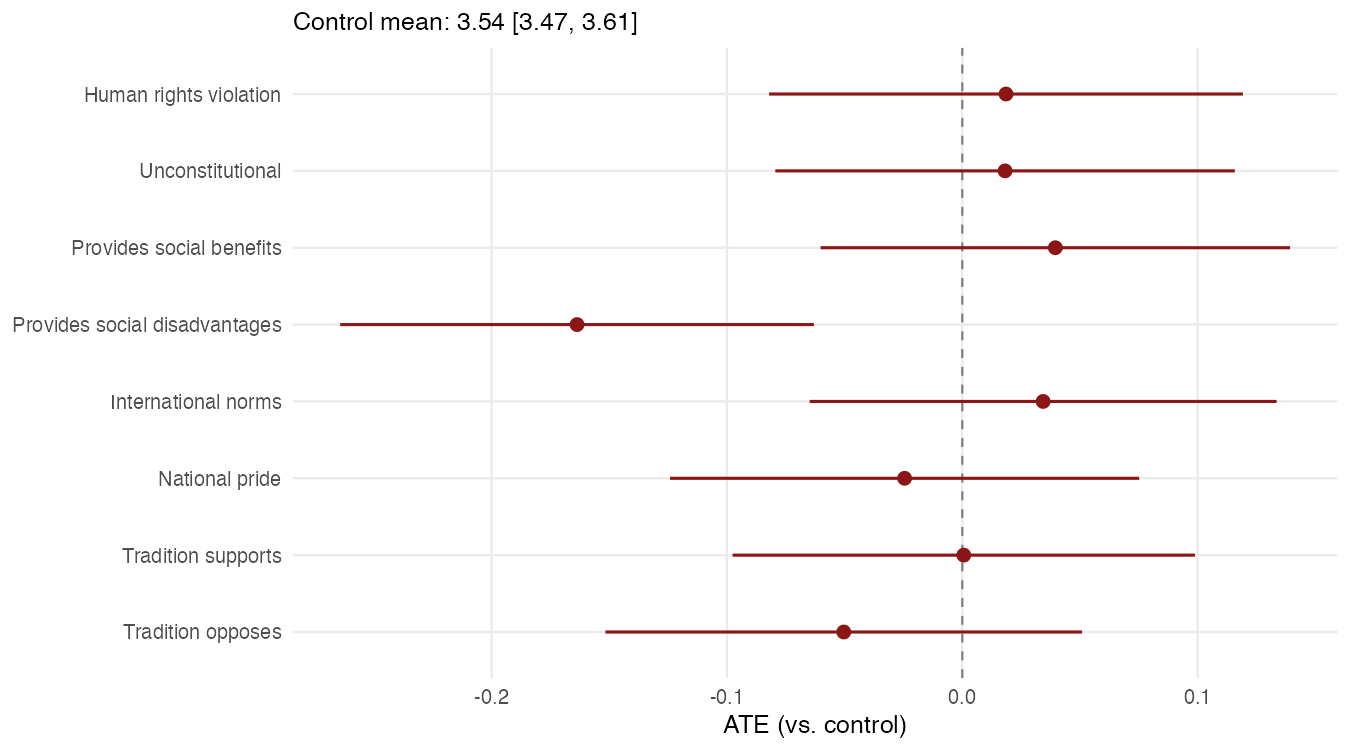
結果変数(日本語): 今日夫婦別姓に関して様々な議論があります。あなたは現在の法律を改めて、結婚後も夫婦がそれぞれ婚姻前の名字を名乗ることができるようにすることについてどうお考えですか?(5段階:非常に賛成〜非常に反対)
Outcome (English): Support for allowing married couples to keep separate surnames (5-point scale, Strongly support to Strongly oppose).
| 条件 (Condition) | 呈示文(日本語) | English framing |
|---|---|---|
| Control | (なし) | (no framing) |
| Tradition opposes | 日本社会では、結婚すれば夫婦が同じ名字を名乗るというのが伝統です。 | Japanese society has had the tradition of married couples having the same surname. |
| Tradition supports | 日本社会では、夫婦が別々の名字を名乗る伝統があり、近代化以前の日本で姓を持っていた人の間でも、明治時代初期の日本でも、結婚後の夫婦別姓が普通でした。 | Japanese society had the tradition of married couples keeping different surnames, and it was common in premodern times as well as in the first few decades of the Meiji era. |
| Provides social benefits | 結婚後に姓を変えるのは大部分が女性であり、これは女性の社会での活躍の阻害要因になっており、日本社会にとっての損失につながります。 | Most of those who change their surname after marriage are women, and this has been a factor preventing women’s advancement in society. |
| Provides social disadvantages | 結婚後に夫婦が別々の名字を名乗ることになれば、家族の絆が弱まり、子供にも悪影響があり、日本社会にとっての損失につながります。 | If married couples use different surnames, it would weaken family bonds and cause harm to children, leading to a loss for Japanese society. |
| International norms | 先進国の中では、夫婦別姓を認めていないのは日本だけで、この点に関する法律を改めることは日本の国際社会での評判に良い影響をもたらします。 | Among developed nations, Japan is the only country that does not allow married couples to keep separate surnames, and changing this law would improve Japan’s reputation in the international community. |
| National pride | 先進国の中では、夫婦別姓を認めていないのは日本だけですが、日本は他国のことなど気にせず、日本国の誇りを守れば良いのです。 | Among developed nations, Japan is the only country that does not allow married couples to keep separate surnames, but Japan should not worry about other countries and maintain its pride. |
| Human rights violation | 人権や男女平等の観点から、女性のほとんどが結婚後に姓を変えるという現在の制度は不公正です。 | From the perspective of human rights and gender equality, the current practice in which most women change their surname after marriage is unfair. |
| Unconstitutional | 結婚後に姓を変えるのは男性でも女性でも良いことになっており、現在の法律が不公正だという批判は当たりません。 | Since the law does not require men nor women to change their name after marriage, the criticism that the current law is unfair is misplaced. |
From Wave 2022 November.