Wave 2022 November
Diet Candidate Profiles, Corporate Board Composition, Surnames Law, and Same-Sex Partnership
This wave fielded a single cross-sectional survey in November 2022.
| Wave | Timing | N |
|---|---|---|
| November 2022 | November 2022 | 7,909 |
Results are reported for the full sample. Conjoint results are marginal means — the unconditional probability of a profile being chosen at each attribute level — with 95% confidence intervals. Vignette results are average treatment effects (ATEs) relative to the control group, estimated via OLS with HC2 standard errors.
Conjoint 1: Diet Candidate Profiles
Respondents evaluated pairs of hypothetical parliamentary (Diet) candidates described along six attributes: gender, age, educational background, prior work experience, marital status, and number of children. They chose which candidate they would prefer to see elected.
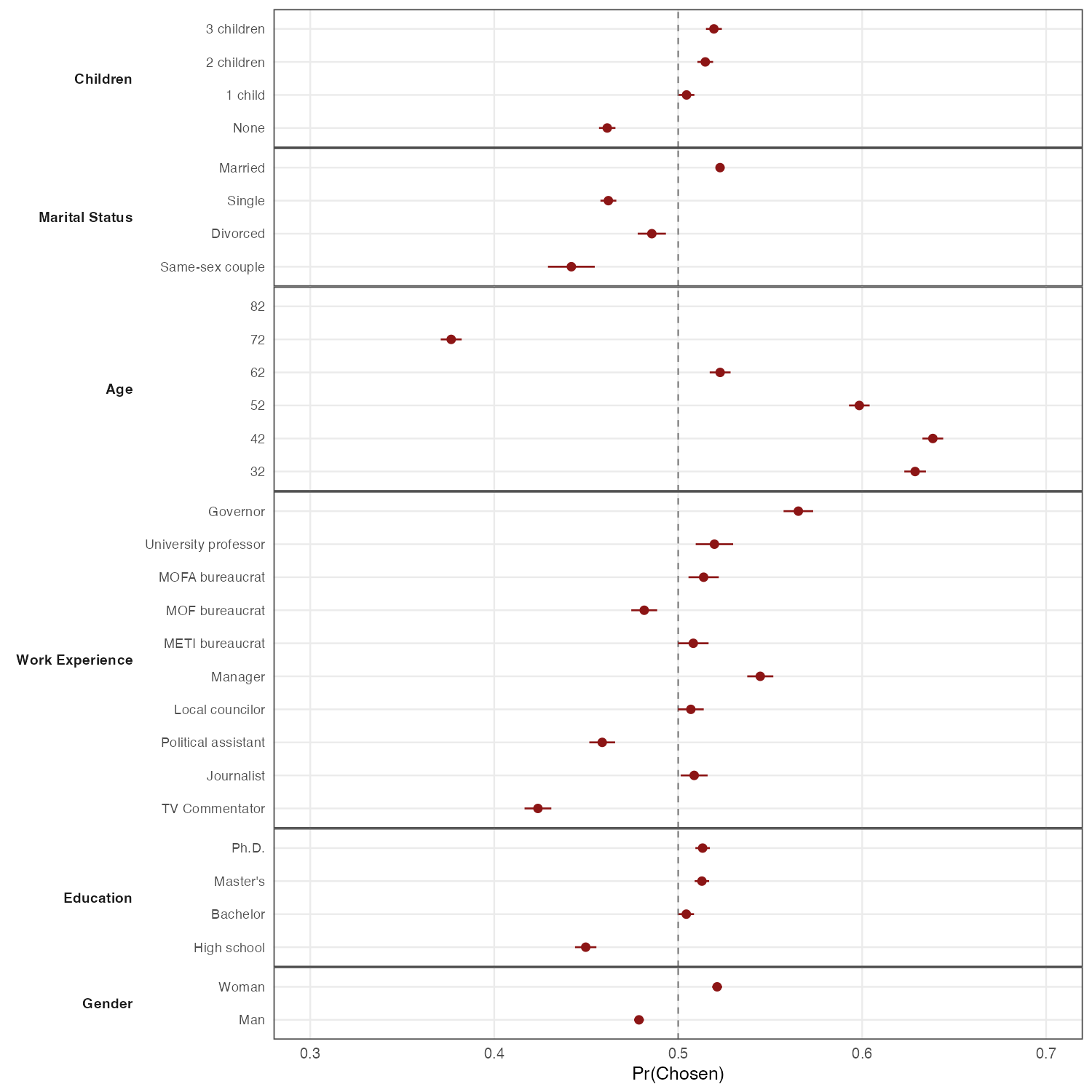
課題(日本語): これから、次の国政選挙にあなたの支持政党からの立候補を考えている(仮想の)候補者の経歴を見ていただきます。それぞれの組み合わせの中から、二人のうちあなたならどちらの候補にこの党の候補として選挙に出てほしいか選んでください。10組の組み合わせを見ていただきます。
Task (English): We would like to ask you to choose an ideal, hypothetical candidate for the next Diet election who would represent the party you support. Please choose one from the following 10 sets of comparisons.
| 属性 (Attribute) | 選択肢(日本語) | Levels (English) |
|---|---|---|
| 性別 (Gender) | 男性; 女性 | Man; Woman |
| 学歴 (Education) | 高校; 大学; 大学院修士; 大学院博士 | High school; Bachelor; Master’s; Ph.D. |
| 職歴 (Work Experience) | ジャーナリスト; テレビコメンテーター; 政治家秘書; 地方議員; 企業経営者; 経産官僚; 財務官僚; 外務官僚; 大学教授; 知事 | Journalist; TV Commentator; Political assistant; Local councilor; Manager; METI bureaucrat; MOF bureaucrat; MOFA bureaucrat; University professor; Governor |
| 年齢 (Age) | 32; 42; 52; 62; 72; 82 | 32; 42; 52; 62; 72; 82 |
| 婚姻状況 (Marital Status) | 同性カップル; 離婚経験あり; 未婚; 既婚 | Same-sex couple; Divorced; Single; Married |
| 子供 (Children) | なし; 1人; 2人; 3人 | None; 1 child; 2 children; 3 children |
Conjoint 2: Corporate Board Composition
Respondents evaluated pairs of hypothetical corporate board member profiles described along the same six attributes, with different work experience categories reflecting corporate and professional backgrounds. They chose which candidate they would prefer to have on a corporate board.
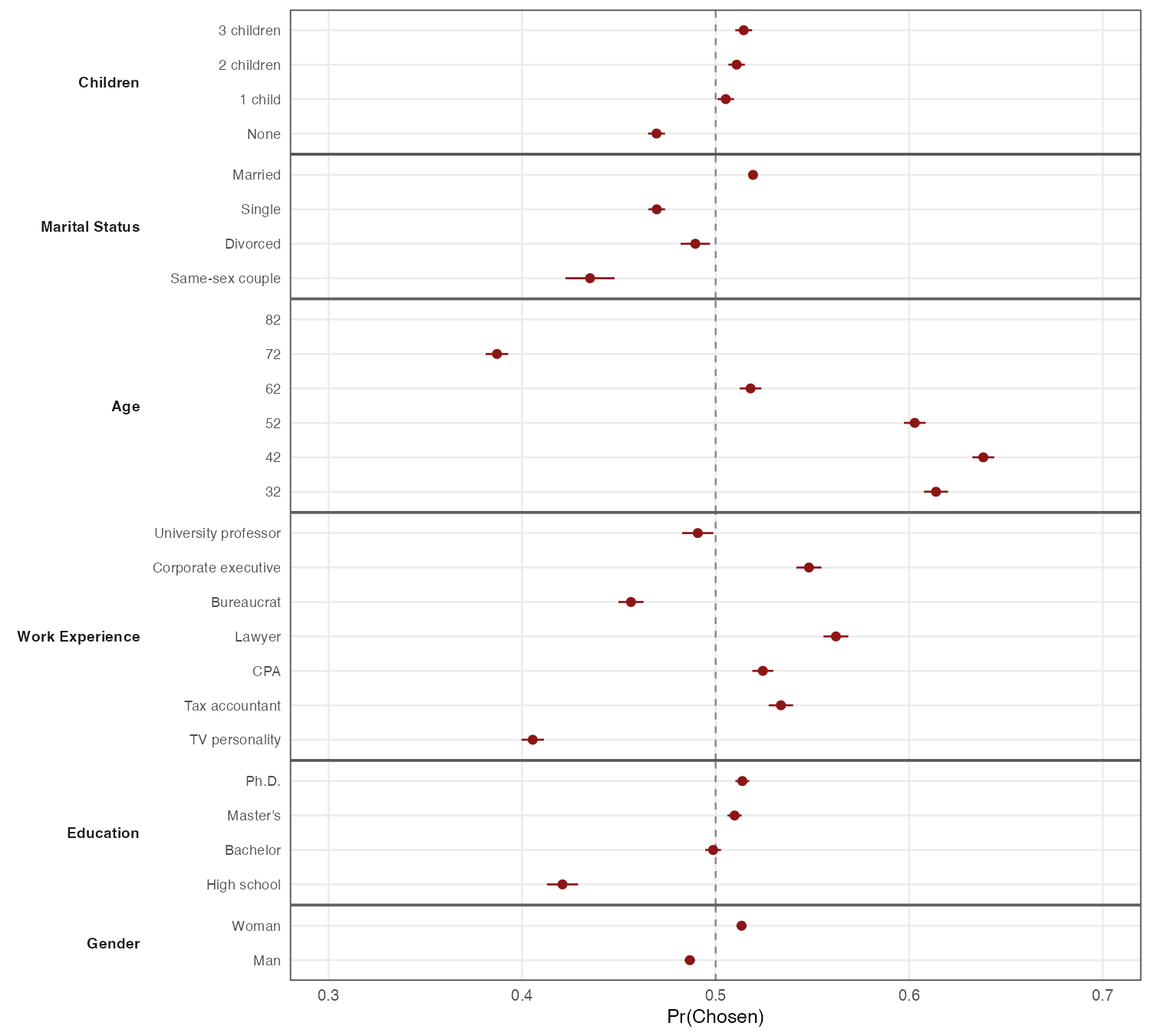
課題(日本語): これから、あなたが株を持っている(という仮定のもとで)ある大企業の社外取締役の(仮想の)候補者の経歴を見ていただきます。それぞれの組み合わせの中から、あなたならどちらの候補を支持するか選んでください。10組の組み合わせを見ていただきます。
Task (English): We would like to ask you to choose an ideal, hypothetical candidate for an external board member at a corporation for which you are a shareholder. Please choose one from the following 10 sets of comparisons.
| 属性 (Attribute) | 選択肢(日本語) | Levels (English) |
|---|---|---|
| 性別 (Gender) | 男性; 女性 | Man; Woman |
| 学歴 (Education) | 高校; 大学; 大学院修士; 大学院博士 | High school; Bachelor; Master’s; Ph.D. |
| 職歴 (Work Experience) | テレビパーソナリティー; 税理士; 公認会計士; 弁護士; 官僚; 企業経営者・役員; 大学教授 | TV personality; Tax accountant; CPA; Lawyer; Bureaucrat; Corporate executive; University professor |
| 年齢 (Age) | 32; 42; 52; 62; 72; 82 | 32; 42; 52; 62; 72; 82 |
| 婚姻状況 (Marital Status) | 同性カップル; 離婚経験あり; 未婚; 既婚 | Same-sex couple; Divorced; Single; Married |
| 子供 (Children) | なし; 1人; 2人; 3人 | None; 1 child; 2 children; 3 children |
Vignette 1: Surnames Law
Before answering the surnames policy question, respondents were randomly assigned to read a short passage framing the issue from one of eight angles — human rights, constitutionality, social benefits, social disadvantages, international norms, national pride, or tradition (for or against) — or to a neutral control. Afterward, they rated their support for allowing married couples to keep separate surnames on a five-point scale.
Figures show average treatment effects (ATEs) relative to the control group, estimated via OLS with HC2 standard errors.
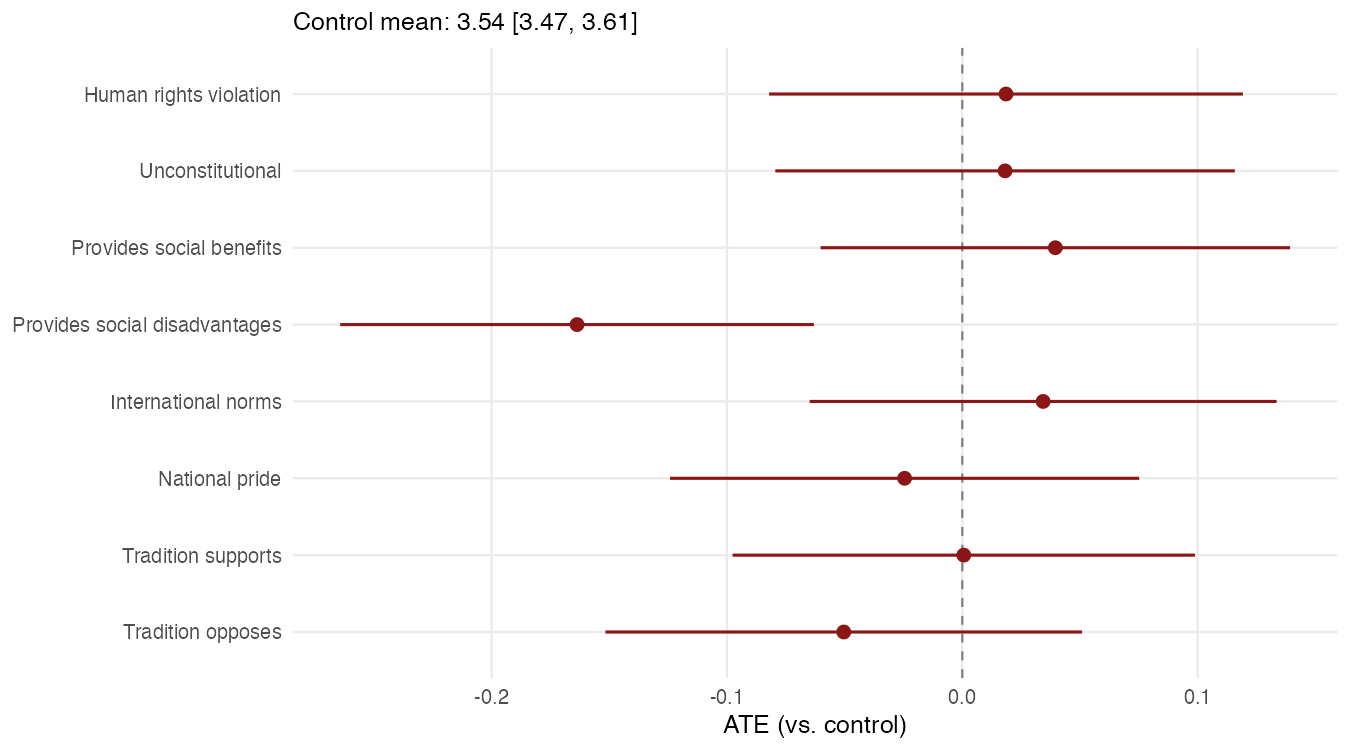
結果変数(日本語): 今日夫婦別姓に関して様々な議論があります。あなたは現在の法律を改めて、結婚後も夫婦がそれぞれ婚姻前の名字を名乗ることができるようにすることについてどうお考えですか?(5段階:非常に賛成〜非常に反対)
Outcome (English): Support for allowing married couples to keep separate surnames (5-point scale, Strongly support to Strongly oppose).
| 条件 (Condition) | 呈示文(日本語) | English framing |
|---|---|---|
| Control | (なし) | (no framing) |
| Tradition opposes | 日本社会では、結婚すれば夫婦が同じ名字を名乗るというのが伝統です。 | Japanese society has had the tradition of married couples having the same surname. |
| Tradition supports | 日本社会では、夫婦が別々の名字を名乗る伝統があり、近代化以前の日本で姓を持っていた人の間でも、明治時代初期の日本でも、結婚後の夫婦別姓が普通でした。 | Japanese society had the tradition of married couples keeping different surnames, and it was common in premodern times as well as in the first few decades of the Meiji era. |
| Provides social benefits | 結婚後に姓を変えるのは大部分が女性であり、これは女性の社会での活躍の阻害要因になっており、日本社会にとっての損失につながります。 | Most of those who change their surname after marriage are women, and this has been a factor preventing women’s advancement in society. |
| Provides social disadvantages | 結婚後に夫婦が別々の名字を名乗ることになれば、家族の絆が弱まり、子供にも悪影響があり、日本社会にとっての損失につながります。 | If married couples use different surnames, it would weaken family bonds and cause harm to children, leading to a loss for Japanese society. |
| International norms | 先進国の中では、夫婦別姓を認めていないのは日本だけで、この点に関する法律を改めることは日本の国際社会での評判に良い影響をもたらします。 | Among developed nations, Japan is the only country that does not allow married couples to keep separate surnames, and changing this law would improve Japan’s reputation in the international community. |
| National pride | 先進国の中では、夫婦別姓を認めていないのは日本だけですが、日本は他国のことなど気にせず、日本国の誇りを守れば良いのです。 | Among developed nations, Japan is the only country that does not allow married couples to keep separate surnames, but Japan should not worry about other countries and maintain its pride. |
| Human rights violation | 人権や男女平等の観点から、女性のほとんどが結婚後に姓を変えるという現在の制度は不公正です。 | From the perspective of human rights and gender equality, the current practice in which most women change their surname after marriage is unfair. |
| Unconstitutional | 結婚後に姓を変えるのは男性でも女性でも良いことになっており、現在の法律が不公正だという批判は当たりません。 | Since the law does not require men nor women to change their name after marriage, the criticism that the current law is unfair is misplaced. |
Vignette 2: Same-Sex Partnership Recognition
Using the same eight framing conditions and control, respondents rated their support for legal recognition of same-sex partnerships on a five-point scale.
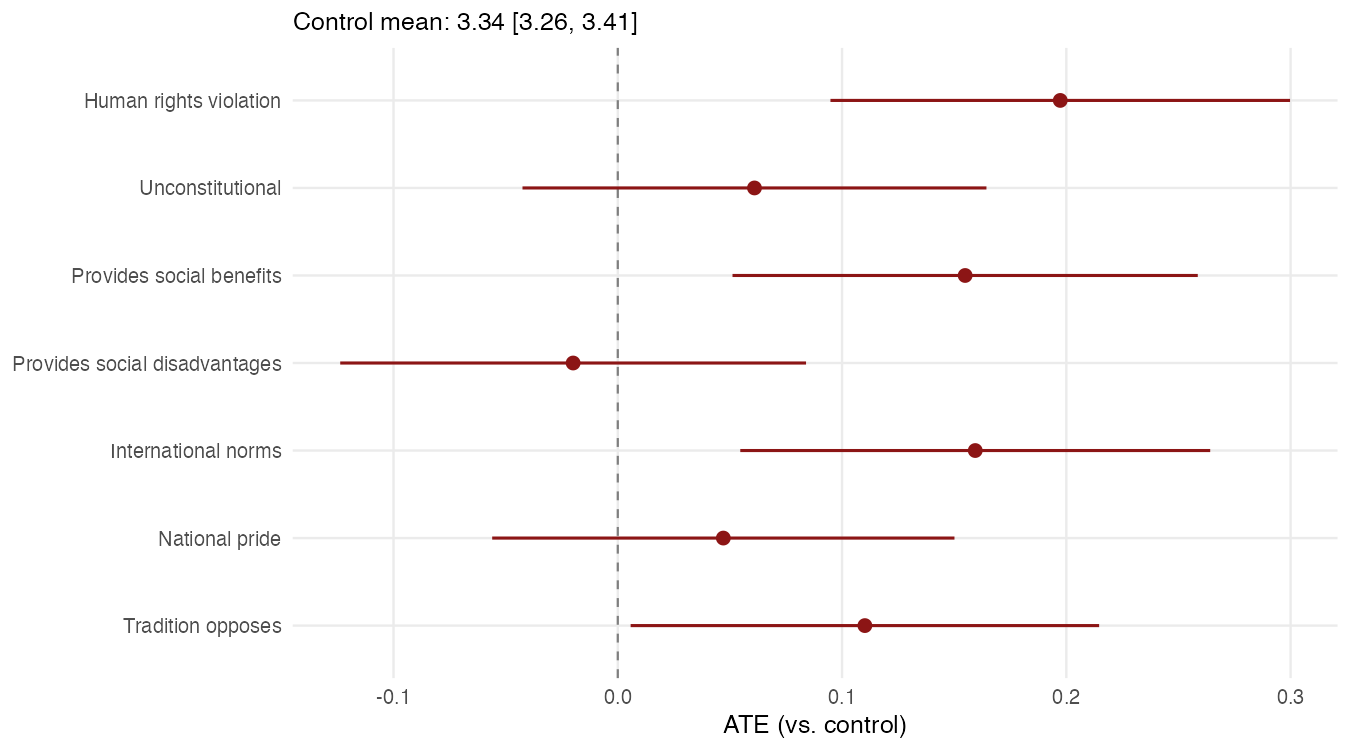
結果変数(日本語): 現在の日本の法体系では、同性間の結婚は認められていません。あなたは現在の法律を改めて、同性婚を認めるようにすることについてどうお考えですか?(5段階:非常に賛成〜非常に反対)
Outcome (English): Support for revising the law to recognize same-sex marriage (5-point scale, Strongly support to Strongly oppose).
| 条件 (Condition) | 呈示文(日本語) | English framing |
|---|---|---|
| Control | (なし) | (no framing) |
| Tradition opposes | 日本社会では、結婚は異性同士の間のものというのが伝統です。 | Japanese society has had the tradition of marriage between opposite sexes. |
| Provides social benefits | 同性婚が認められれば、同性カップルによる子育てもしやすくなり、少子化問題の改善につながる可能性があり、日本社会にとって有益な効果が期待できます。 | If same-sex marriage is allowed, that would make it easier for same-sex couples to raise children, which has the potential for improving the problem of the shrinking population and bringing benefits to Japanese society. |
| Provides social disadvantages | 同性婚が認められれば、異性間の結婚が減り、少子化がさらに進む可能性があり、日本社会にとっての損失につながる恐れがあります。 | If same-sex marriage is allowed, that could reduce heterosexual marriages and further exacerbate the problem of the shrinking population, causing harm to Japanese society. |
| International norms | 先進国の中では、同性婚を認めている国が多く、日本でも同性婚を認めれば、日本の国際社会での評判に良い影響をもたらします。 | Many developed nations allow same-sex marriage, and if Japan does the same, that would improve Japan’s reputation in the international community. |
| National pride | 先進国の中では、同性婚を認めている国が多いですが、日本は他国のことなど気にせず、日本国の誇りを守れば良いのです。 | Many developed nations allow same-sex marriage, but Japan should not worry about other countries and maintain its pride. |
| Human rights violation | 人権やジェンダー平等の観点から、同性婚を認めないのは不公正です。 | From the perspective of human rights and gender equality, it is unfair for same-sex couples to not be able to get married. |
| Unconstitutional | 憲法に結婚は「両性の合意のみ」に基づくとされているのだから、同性婚を認めないのは公正なことです。 | Since the constitution specifies marriage to be based on “consent between two sexes”, it is fair to ban same-sex marriage. |