Japanese Public Favors Skilled, Japanese-Speaking Immigrants — But Resistance to Chinese Applicants Remains Strong
A three-wave panel of the Stanford Japan Barometer, fielded around the February 2026 Japanese general election, reveals that Japanese public opinion on immigration is highly sensitive to who is applying and how the issue is framed — with skill level, language ability, and national origin all playing significant roles. The patterns are stable across sub-waves, but negative framing effects — particularly security rhetoric — have grown stronger one month after the election.
Who Gets In? Skill and Language Matter Most
The survey asked respondents to choose between pairs of hypothetical immigration applicants described across nine characteristics. By randomly varying these characteristics across thousands of choices, the study isolates which factors most shape admission preferences.
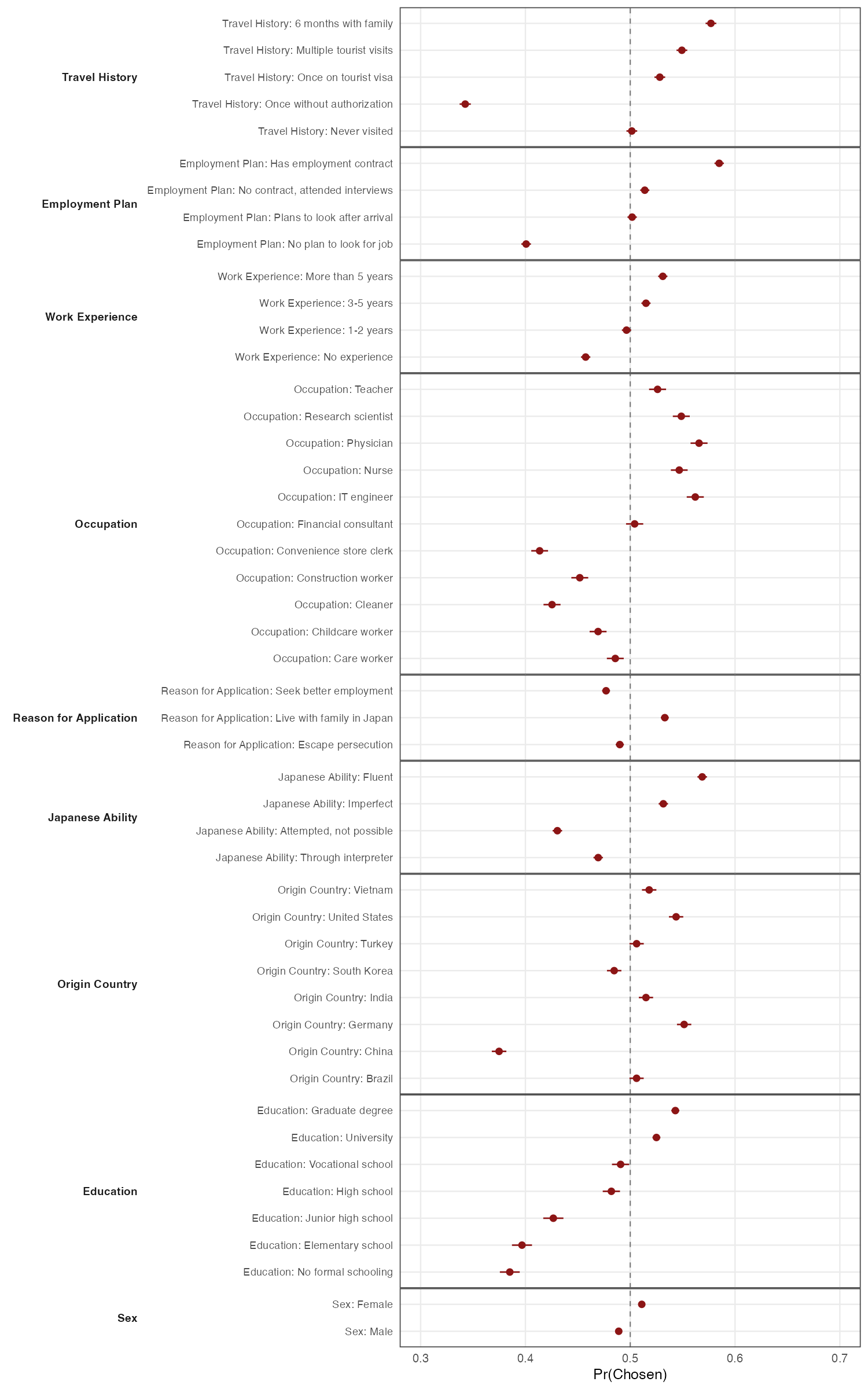
Occupation is one of the strongest drivers. Respondents strongly favor high-skilled professionals — physicians, IT engineers, and research scientists are selected at rates around 55–56%, while convenience store clerks and cleaners are preferred at only 42–43%. Japanese public opinion on immigration is not simply pro- or anti-immigrant: it is highly selective.
Japanese language ability also matters greatly. Fluent speakers are chosen 57% of the time, while applicants who attempted Japanese but could not hold a conversation are chosen only 43% of the time — a 14 percentage point gap. This suggests that language integration is a primary concern for the Japanese public.
Strong Preference for Western Applicants — China a Clear Exception
Among national origins, respondents show clear preferences. Applicants from Germany and the United States are most favored (around 55%), followed by Vietnam, India, Turkey, and Brazil (around 51–53%). South Korean applicants are slightly below the midpoint (around 48%).
Applicants from China stand out sharply: they are chosen only 37–39% of the time — roughly 16–19 percentage points below German applicants, and far below every other origin country tested. This gap persists even when other characteristics such as occupation, education, and language ability are held constant, suggesting that resistance to Chinese immigration reflects broader geopolitical concerns rather than perceptions of skill or integration potential.
Language Ability Helps Less for Chinese Applicants
A closer look at the interaction between national origin and Japanese language ability reveals a striking pattern. The figure below shows marginal means across all four Japanese ability levels for each origin country — from communicating through an interpreter to speaking fluently.
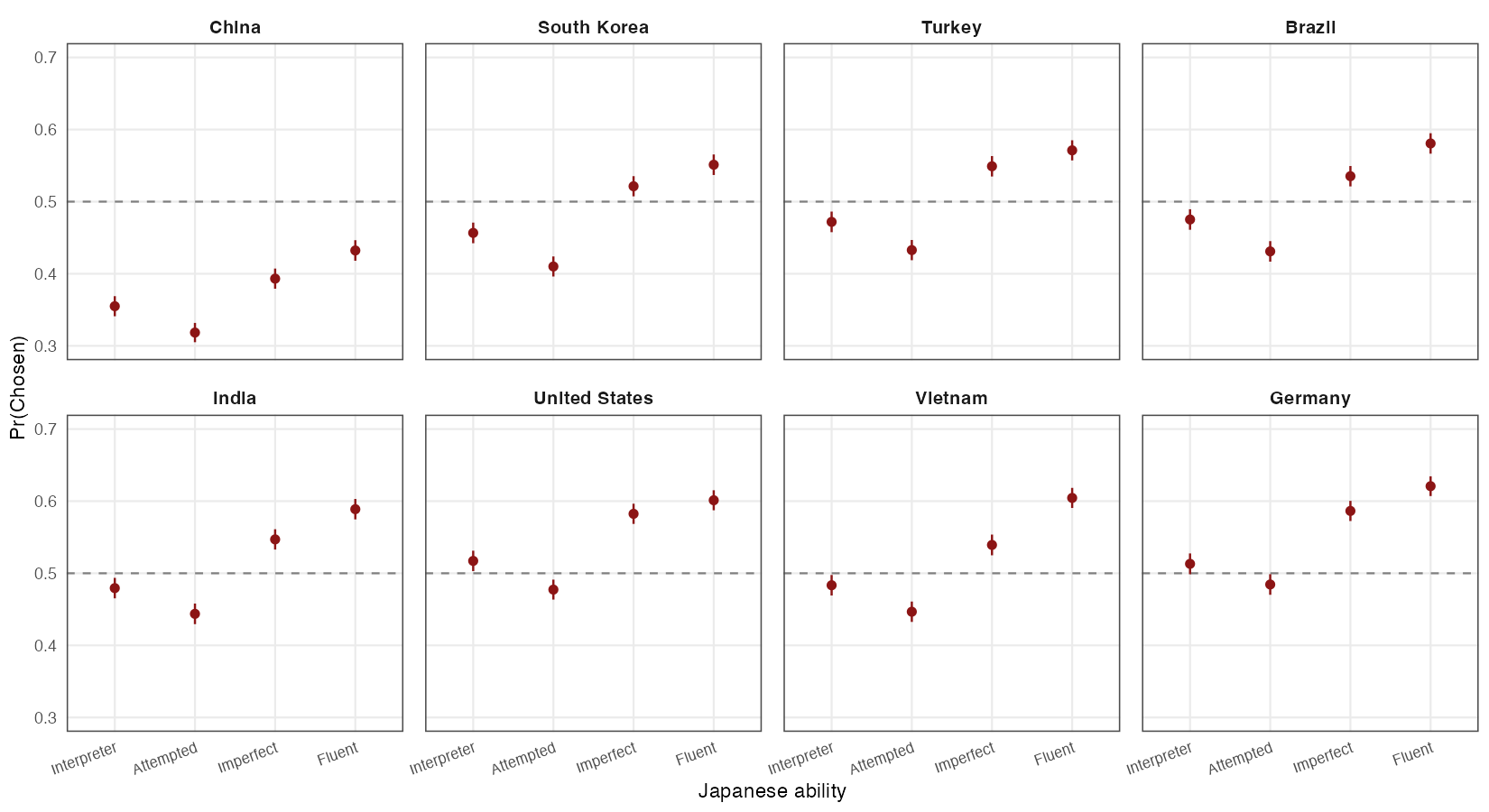
The language gradient is visible in every country — more fluent applicants are consistently more favored. But China’s panel sits far below the rest at every level. A fluent Chinese applicant is chosen only 43% of the time, while even a German or American applicant using an interpreter reaches 51–52%. The rise from interpreter to fluent is also somewhat smaller for China (~8 pp) than for Vietnam, India, or Germany (~10–12 pp). This suggests that resistance to Chinese applicants is not primarily a concern about language integration — the origin penalty persists regardless of fluency, pointing to deeper geopolitical or cultural skepticism.
How Immigration Is Framed Shapes Public Opinion
In a companion experiment, respondents were randomly assigned to read a short passage framing immigration from a particular angle before answering whether they support expanding immigration to Japan.
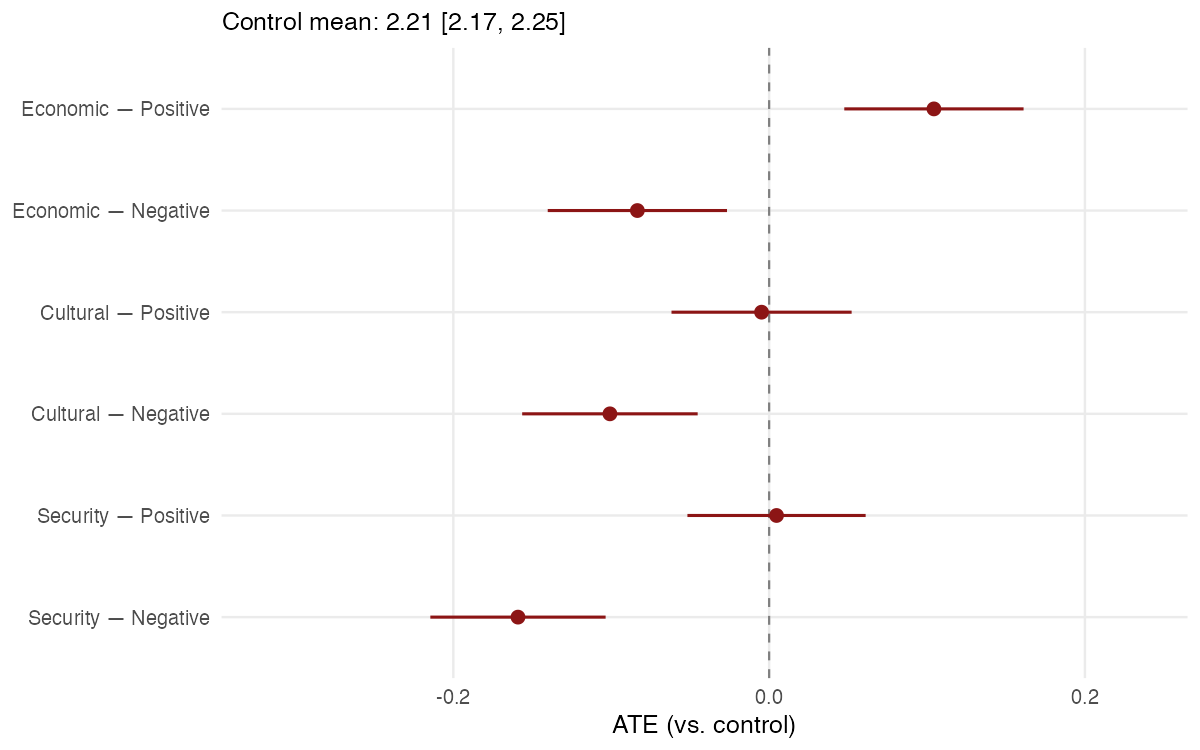
Positive economic framing significantly raises support. Respondents who read about immigration’s contributions to labor shortages and tax revenues were more supportive than the control group across all three sub-waves (effects: +0.12, +0.10, +0.10 on a 4-point scale).
Negative framings reduce support — and the effects have grown stronger. The security-negative framing shows the largest and most consistent effect: −0.13 (before election), −0.15 (one week after), and −0.21 (one month after). Negative economic framing, not significant before the election, became significant one month after (−0.13, p = 0.008). Negative cultural framing has also strengthened, reaching −0.15 (p = 0.002) in the third sub-wave.
Positive cultural and security framings had no statistically significant effect in any wave.
Conjoint Preferences Stable Across All Three Waves
The February 2026 survey was fielded in three sub-waves — before the election, one week after, and one month after. Preferences by occupation, language ability, and national origin are highly stable across all three waves. China’s selection rate remains the lowest in every wave (37–39%), Germany and the United States remain the most preferred (54–56%), and the occupational hierarchy is unchanged. No attribute level shifts by more than three percentage points across sub-waves.
The election — and the subsequent government formation — does not appear to have meaningfully shifted conjoint-measured immigration preferences. The framing experiment tells a somewhat different story, however: while the direction of all effects is consistent, negative framings have become numerically larger in the third sub-wave, suggesting that one month after the election, the Japanese public may be more responsive to anti-immigration rhetoric.
Implications
These findings suggest that Japanese public support for immigration depends heavily on the type of immigrant being considered and how the policy is communicated. High-skilled, Japanese-speaking immigrants face the most favorable reception. Economic arguments can move opinion in a pro-immigration direction, while security and cultural rhetoric — prominent in recent political debates — significantly dampen it, with effects that appear to have strengthened one month after the election.
The language × origin interaction adds a further layer: for Chinese applicants, language fluency provides a much smaller boost than for applicants from other countries. This implies that policies aimed at encouraging Japanese-language learning among Chinese immigrants may have limited effect on public acceptance, and that the resistance is rooted in something beyond communication concerns.
Data from the Stanford Japan Barometer, Wave 2026 February — three sub-waves (N = 4,077 before election; N = 4,073 one week after; N = 4,601 one month after). See full results and methods for details.