Wave 2026 February
Taiwan Contingency, Defence Policy, Immigration, and Immigration Framing
This wave fielded a three-sub-wave panel study around the 2025 Japanese general election.
| Sub-wave | Timing | N |
|---|---|---|
| February 2026 — Before Election | Feb 6–8, 2026 | 4,077 |
| February 2026 — A Week After Election | Feb 13–16, 2026 | 4,073 |
| February 2026 — A Month After Election | Mar 20–23, 2026 | 4,601 |
The wave included three conjoint experiments and one vignette experiment. Use the tabs in each section to view results by sub-wave. Conjoint results are reported as marginal means — the unconditional probability of a profile being chosen at each attribute level — with 95% confidence intervals. Values above 0.5 indicate above-average preference; below 0.5 indicate below-average preference.
Conjoint 1: Taiwan Contingency
Respondents evaluated pairs of hypothetical Taiwan-crisis scenarios described along five attributes: China’s action toward Taiwan, the US response, China’s action toward Japan, the US request to Japan, and the stance of the international community.
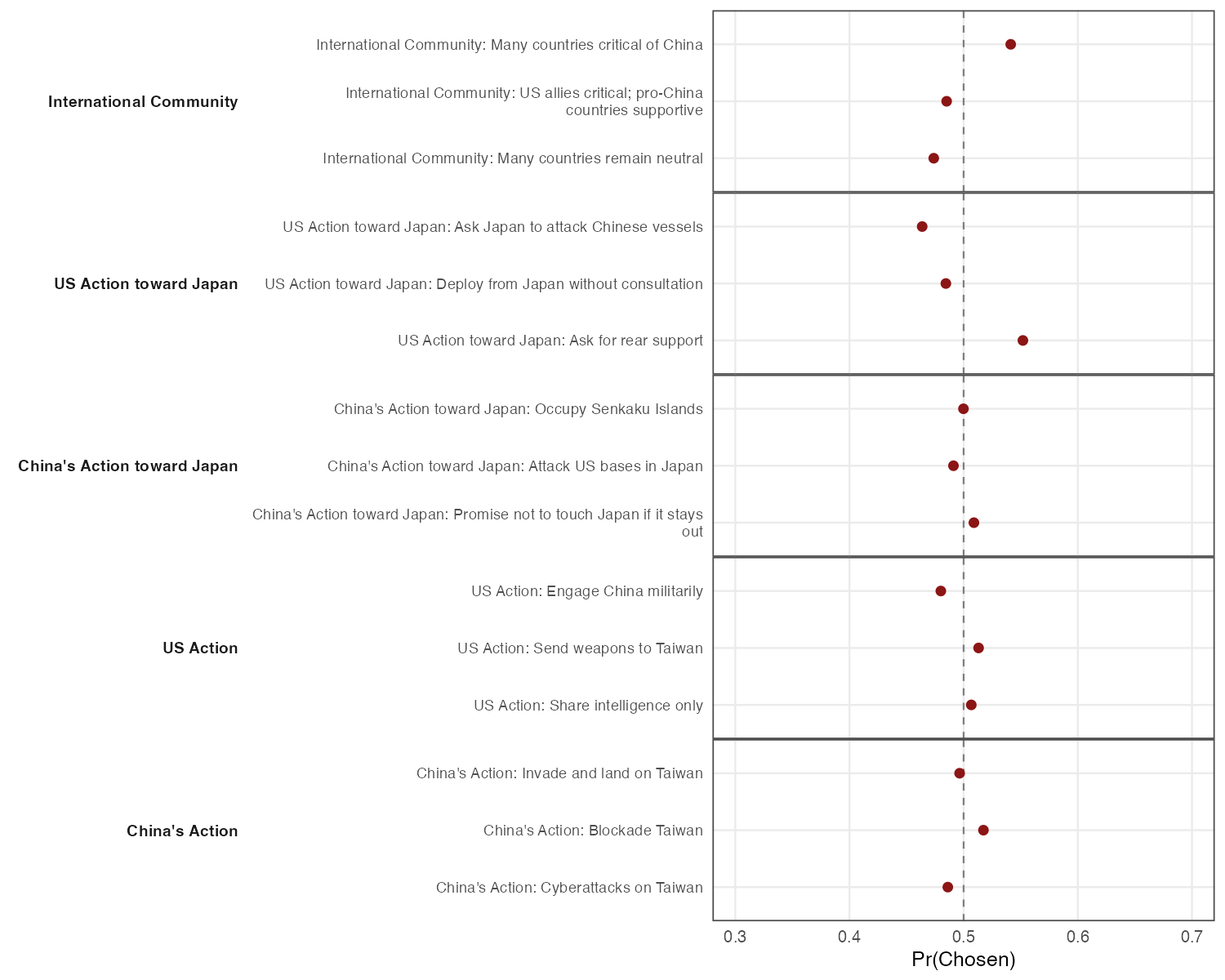
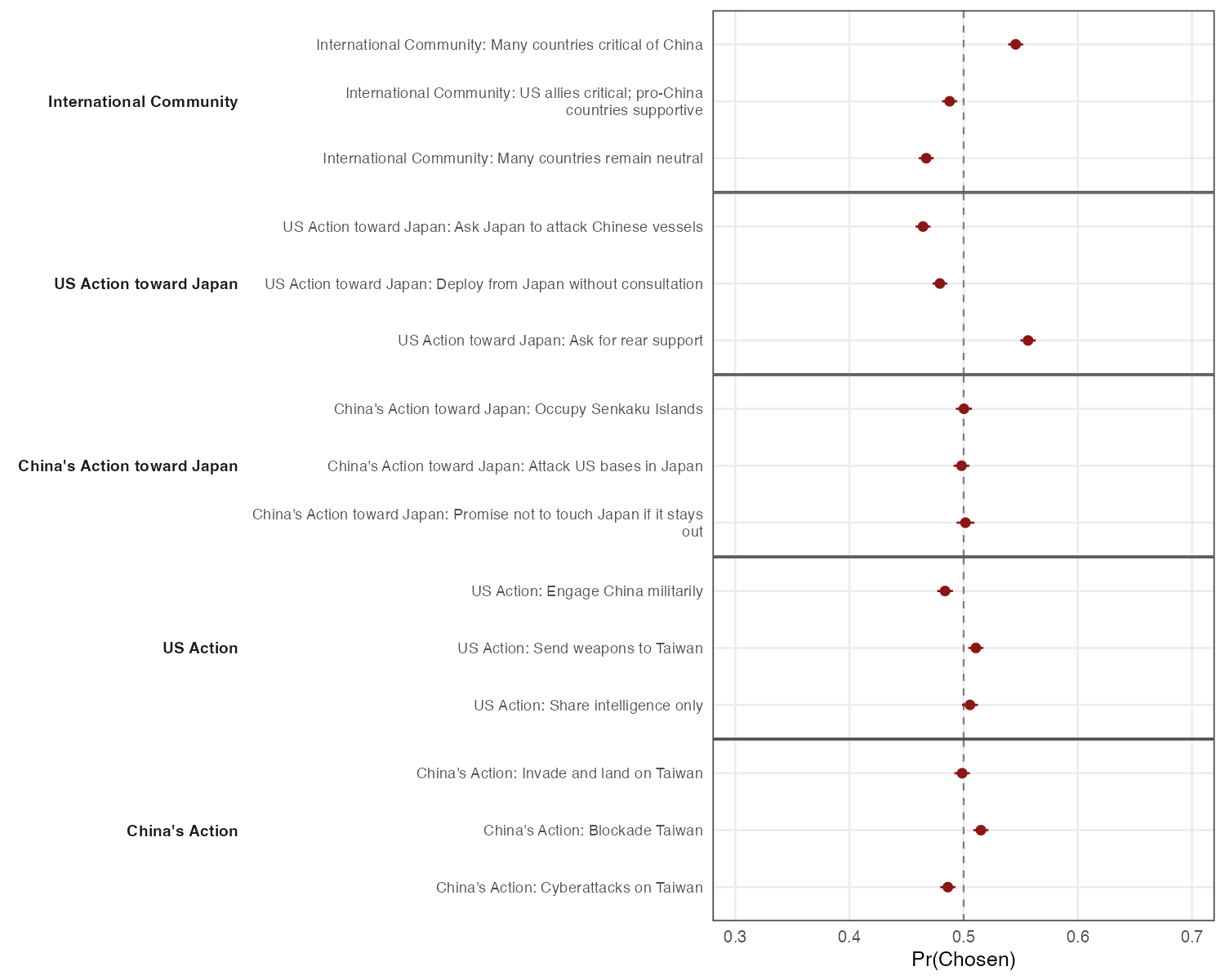
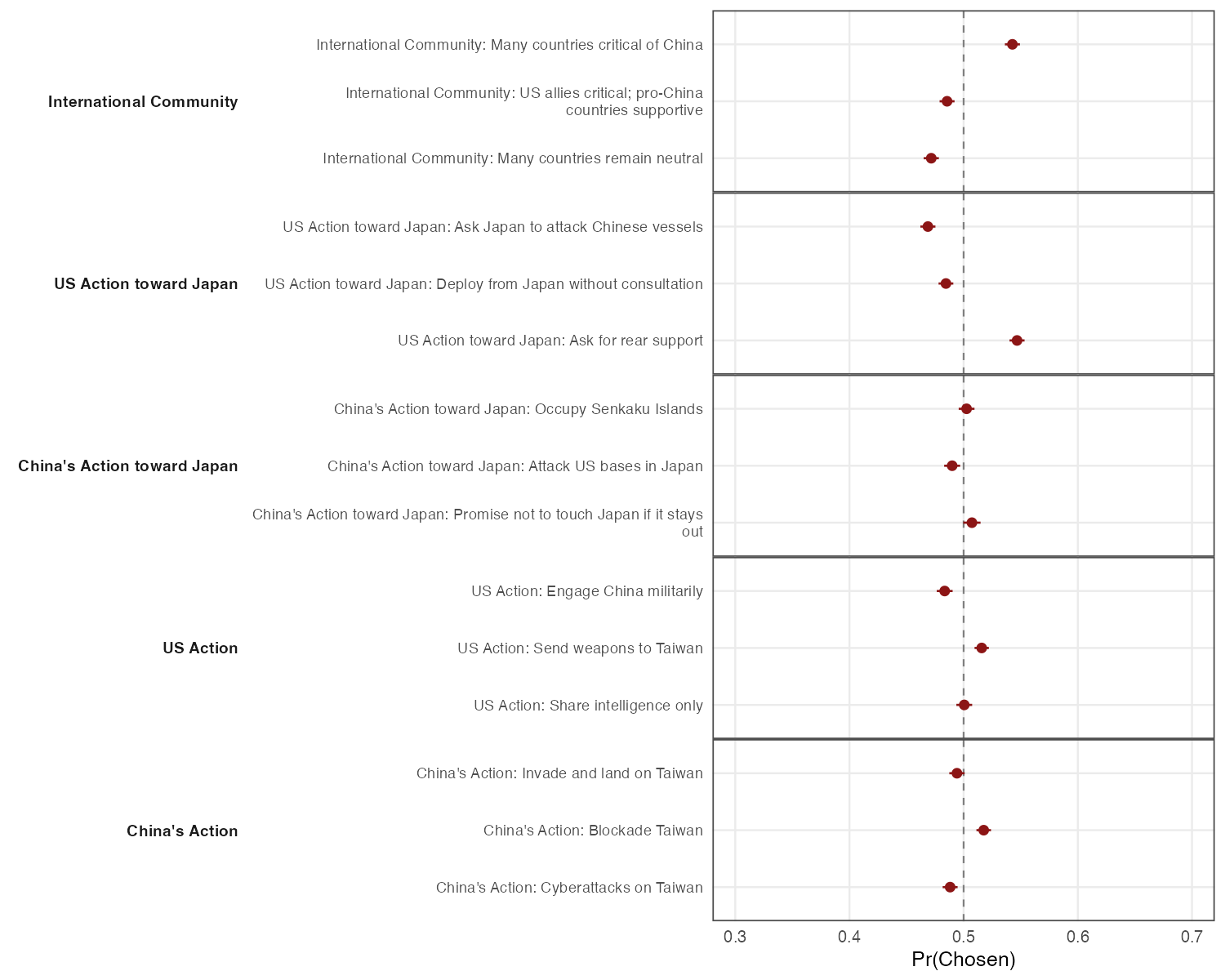
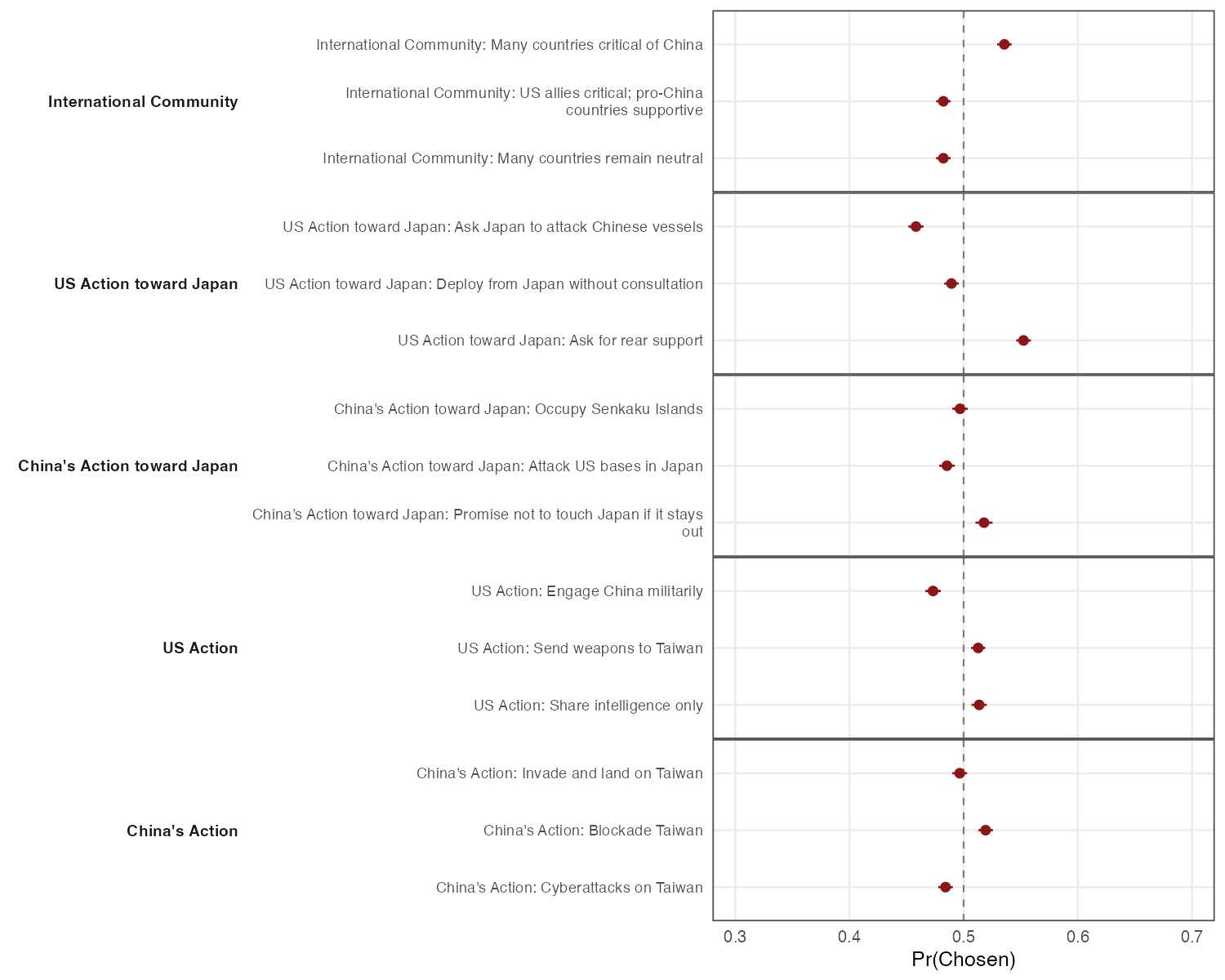
課題(日本語): 仮想の台湾危機シナリオのペアを評価し、日本としてどちらに対処することを望むかを選んでください。
Task (English): Respondents evaluated pairs of hypothetical Taiwan-crisis scenarios and chose which scenario they would prefer Japan to address.
| 属性 (Attribute) | 選択肢(日本語) | Levels (English) |
|---|---|---|
| 中国の行動 (China’s Action) | 台湾にサイバー攻撃を仕掛け都市機能などを麻痺させる; 台湾の周りを海上封鎖し、台湾への物資を全て遮断する; 台湾に軍事侵攻して上陸する | Cyberattacks on Taiwan; Blockade Taiwan; Invade and land on Taiwan |
| アメリカの行動 (US Action) | 台湾に情報提供などするが軍事的関与はしない; 台湾に武器供与し反撃を助ける; 台湾へ空海軍を送り込み中国と交戦する | Share intelligence only; Send weapons to Taiwan; Engage China militarily |
| 日本に対する中国の行動 (China’s Action toward Japan) | 日本が軍事的に関与しなければ、尖閣諸島も含めた日本の領土に対しては手を出さないと約束する; 沖縄の嘉手納基地などの在日米軍基地に攻撃を仕掛ける; 尖閣諸島に上陸し占領する | Promise not to touch Japan if it stays out; Attack US bases in Japan; Occupy Senkaku Islands |
| 日本に対するアメリカの行動 (US Action toward Japan) | 台湾での米国の行動に対する後方支援を要請; 日本との事前協議での了承を経ずに在日米軍基地から台湾へ軍事力を展開; 台湾近海へ自衛隊を配備し中国艦船へ攻撃することを要請 | Ask for rear support; Deploy from Japan without consultation; Ask Japan to attack Chinese vessels |
| 国際社会 (International Community) | 多くの国が強い意見を表明せず中立的である; アメリカの同盟国が中国に批判的な一方で、ロシアなど中国寄りの国は中国を支持している; 多くの国が中国の行動に批判的である | Many countries remain neutral; US allies critical, pro-China countries supportive; Many countries critical of China |
Conjoint 2: Defence Policy
Respondents evaluated pairs of hypothetical Japanese defence policy packages described along five attributes: primary goal, the biggest perceived threat, new strategic domain, defence budget source, and nuclear policy stance.
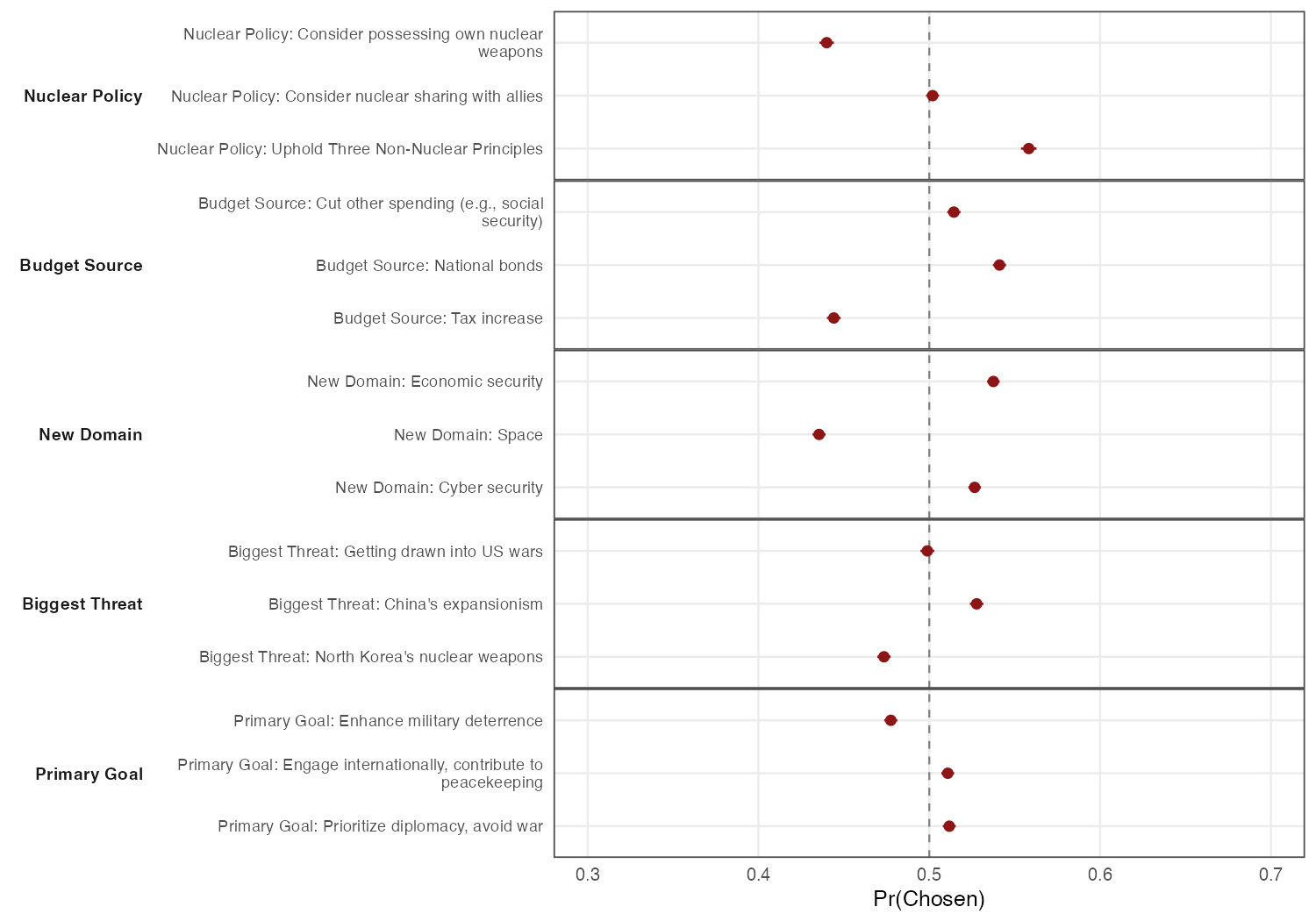
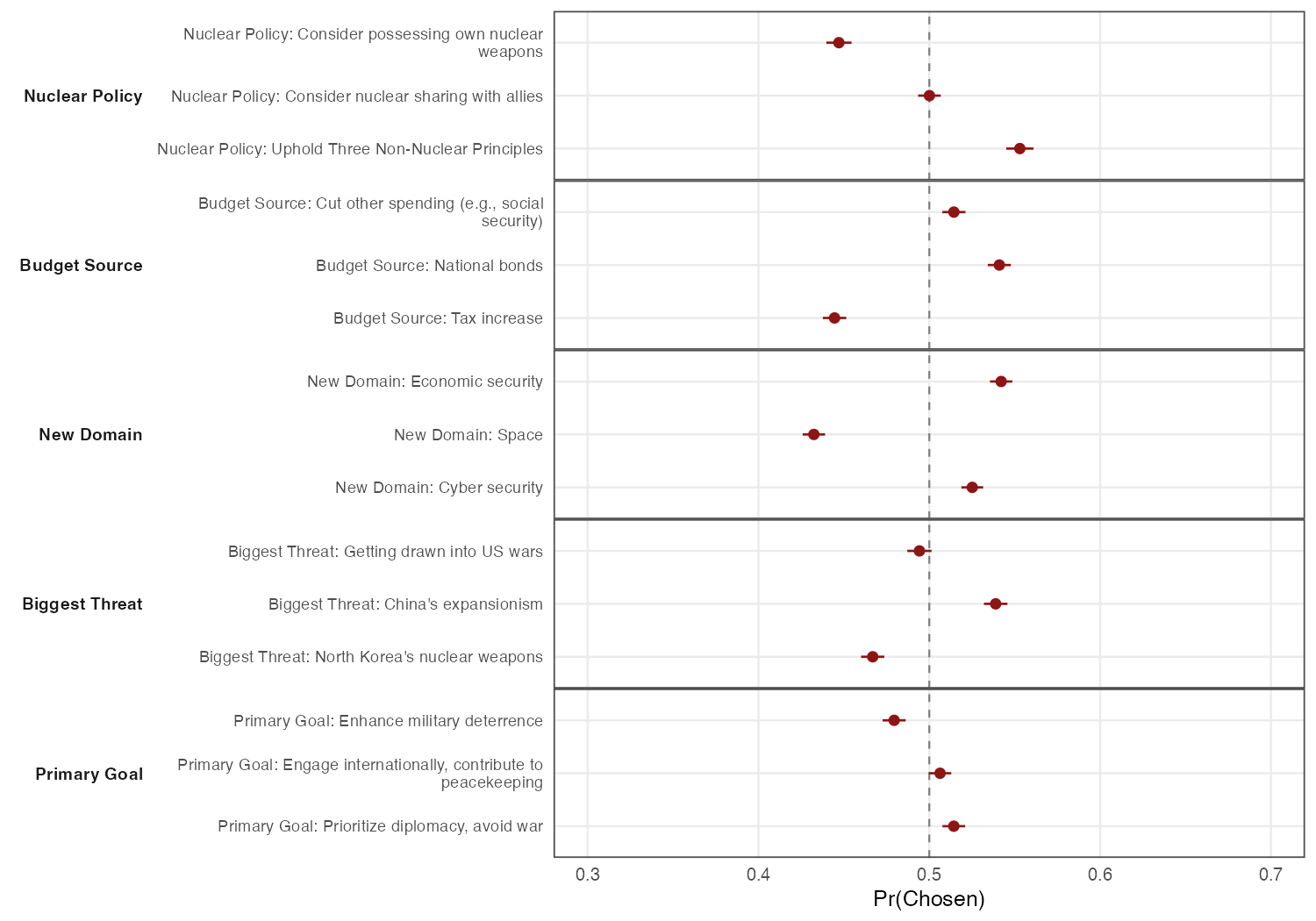
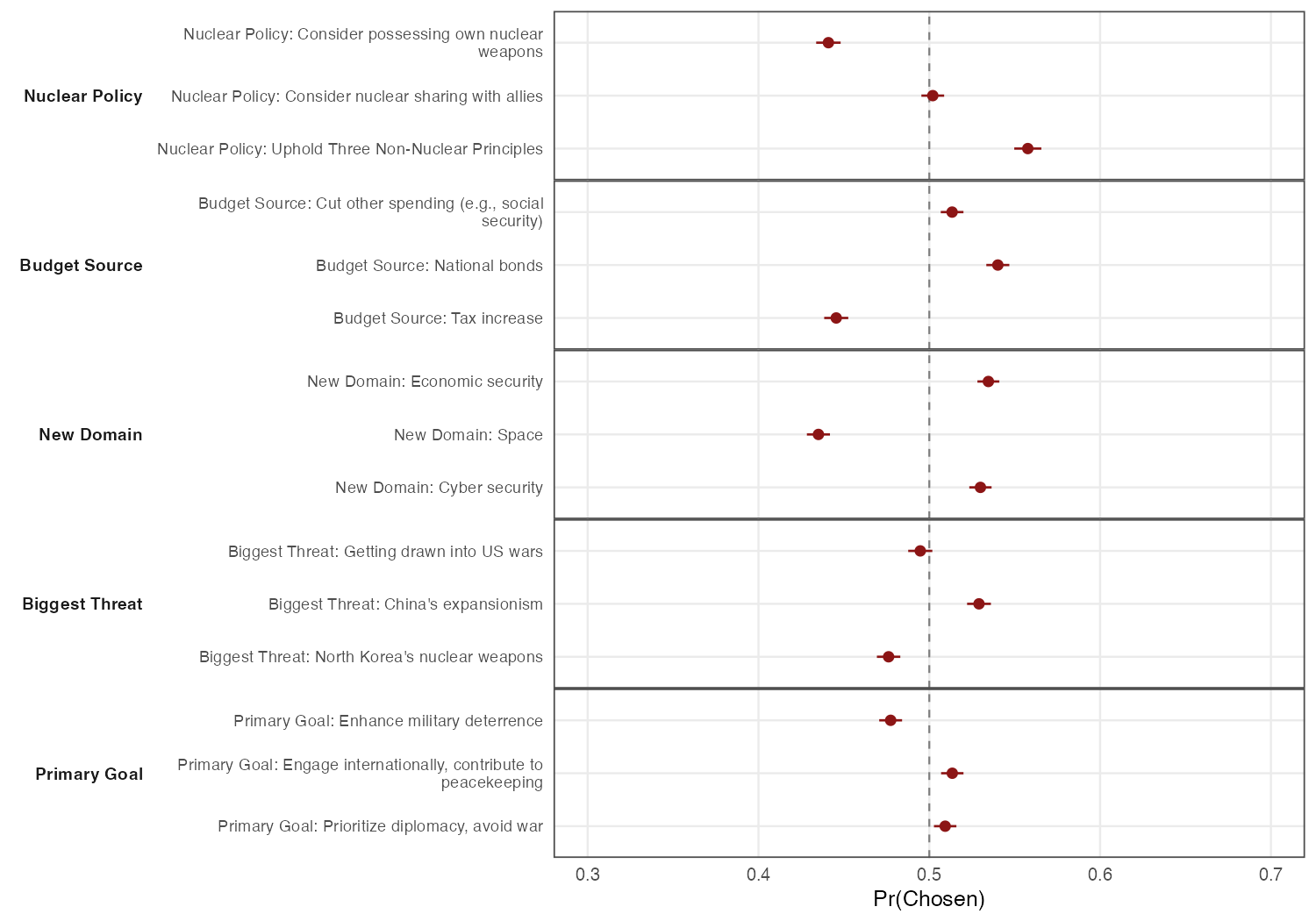
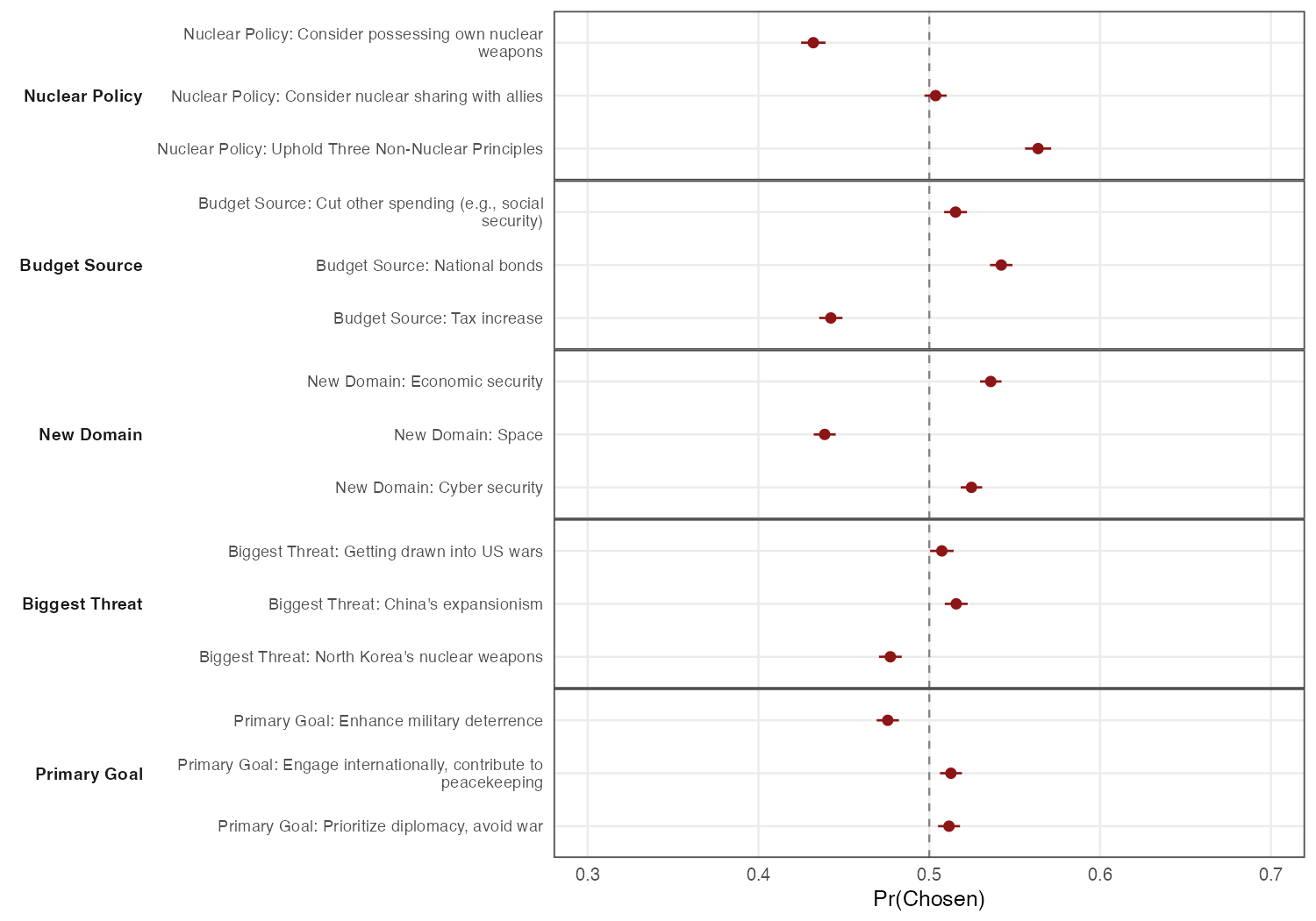
課題(日本語): 仮想の日本の防衛政策パッケージのペアを評価し、どちらを好むかを選んでください。
Task (English): Respondents evaluated pairs of hypothetical Japanese defence policy packages and chose which package they preferred.
| 属性 (Attribute) | 選択肢(日本語) | Levels (English) |
|---|---|---|
| 主要な目標 (Primary Goal) | 外交を重視し、決して戦争に巻き込まれないようにする; 積極的に国際社会に関与し、平和維持に貢献する; 軍事的抑止力を強化し、国民と領土を守る | Prioritize diplomacy, avoid war; Engage internationally, contribute to peacekeeping; Enhance military deterrence |
| 日本にとって最大の脅威 (Biggest Threat) | 北朝鮮の核開発; 中国の覇権主義; アメリカの戦争に巻き込まれること | North Korea’s nuclear weapons; China’s expansionism; Getting drawn into US wars |
| 重視するべき新たな分野 (New Domain) | サイバーセキュリティー; 宇宙; 経済安全保障 | Cyber security; Space; Economic security |
| 防衛費の財源 (Budget Source) | 増税; 国債; 社会保障費など他の予算を削る | Tax increase; National bonds; Cut other spending (e.g., social security) |
| 核保有 (Nuclear Policy) | 非核三原則を堅持するべき; 同盟国による日本での核配備(核共有)を検討するべき; 日本の核保有を検討するべき | Uphold Three Non-Nuclear Principles; Consider nuclear sharing with allies; Consider possessing own nuclear weapons |
Conjoint 3: Immigration Applicant Preferences
Respondents evaluated pairs of hypothetical immigration applicants described along nine attributes: country of origin, reason for application, prior visits to Japan, occupation, work experience, employment plan, sex, Japanese language ability, and education.
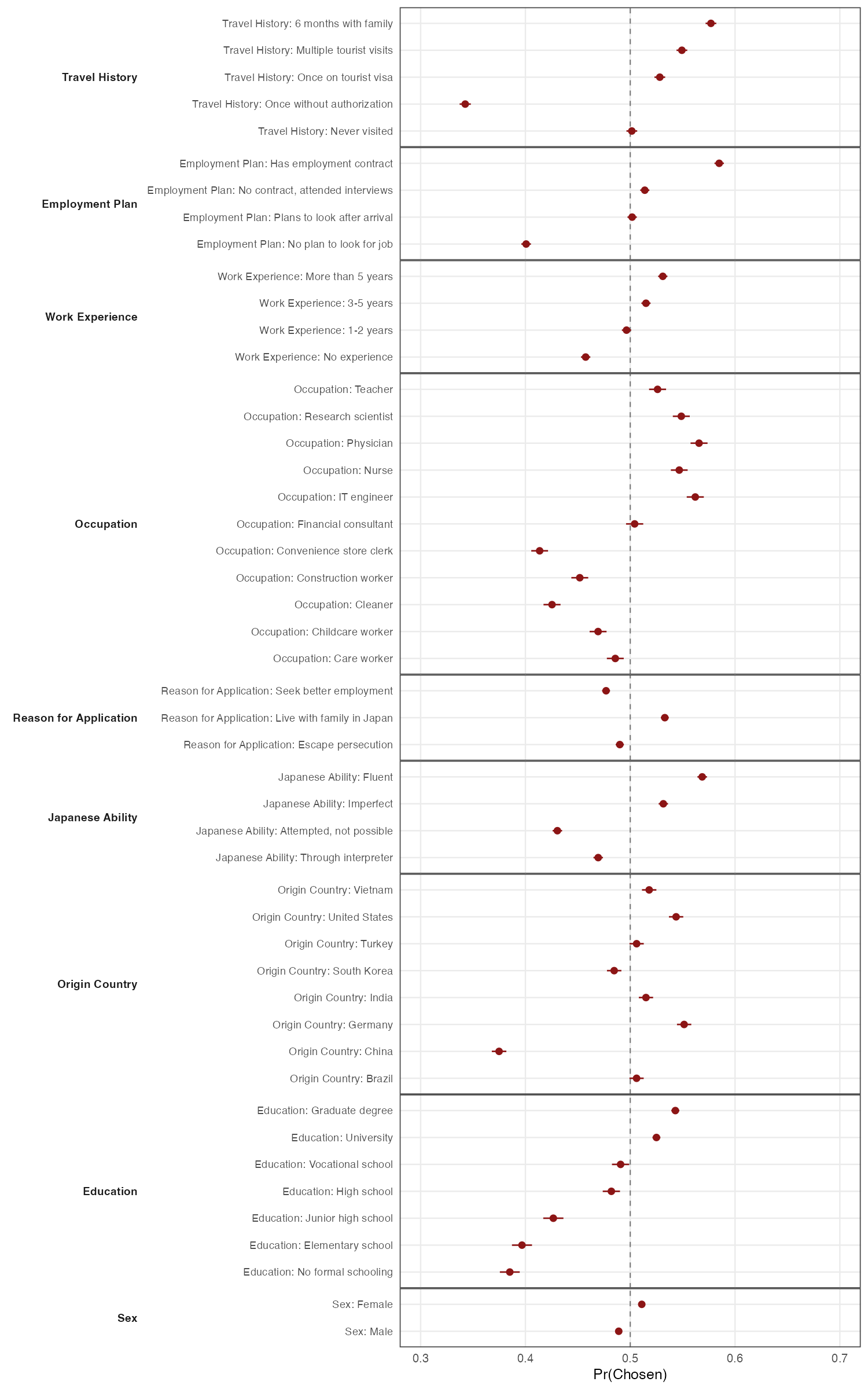
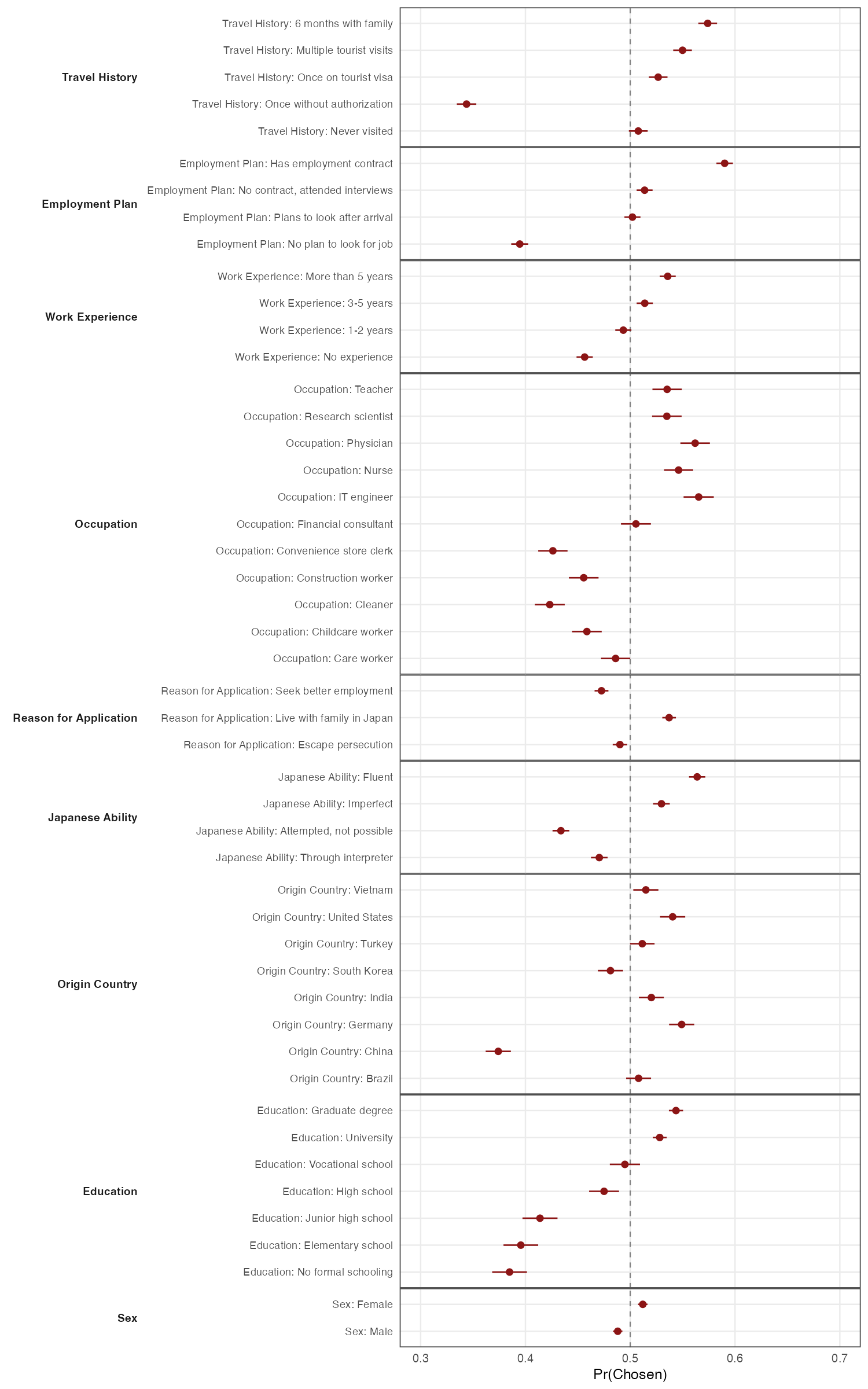
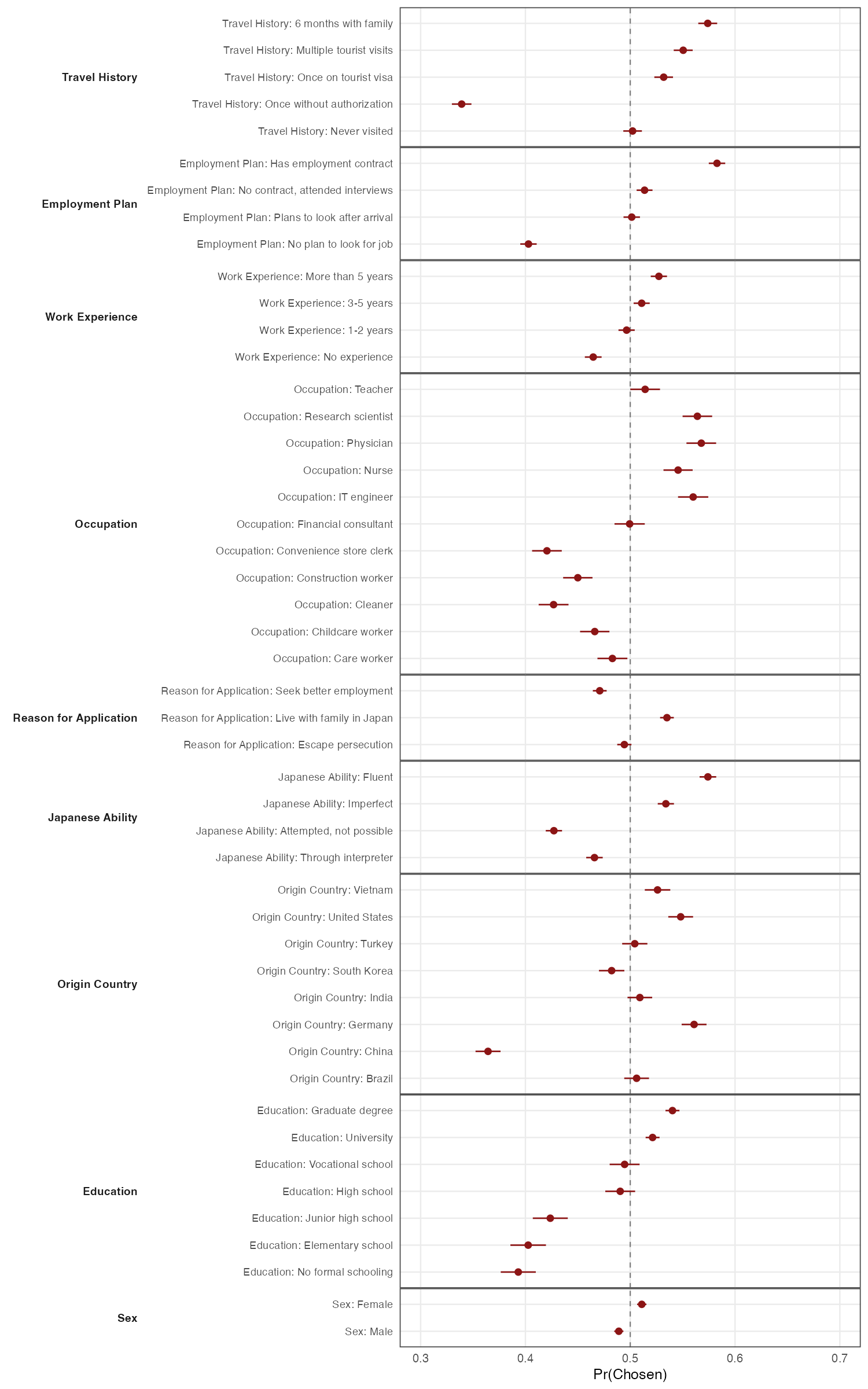
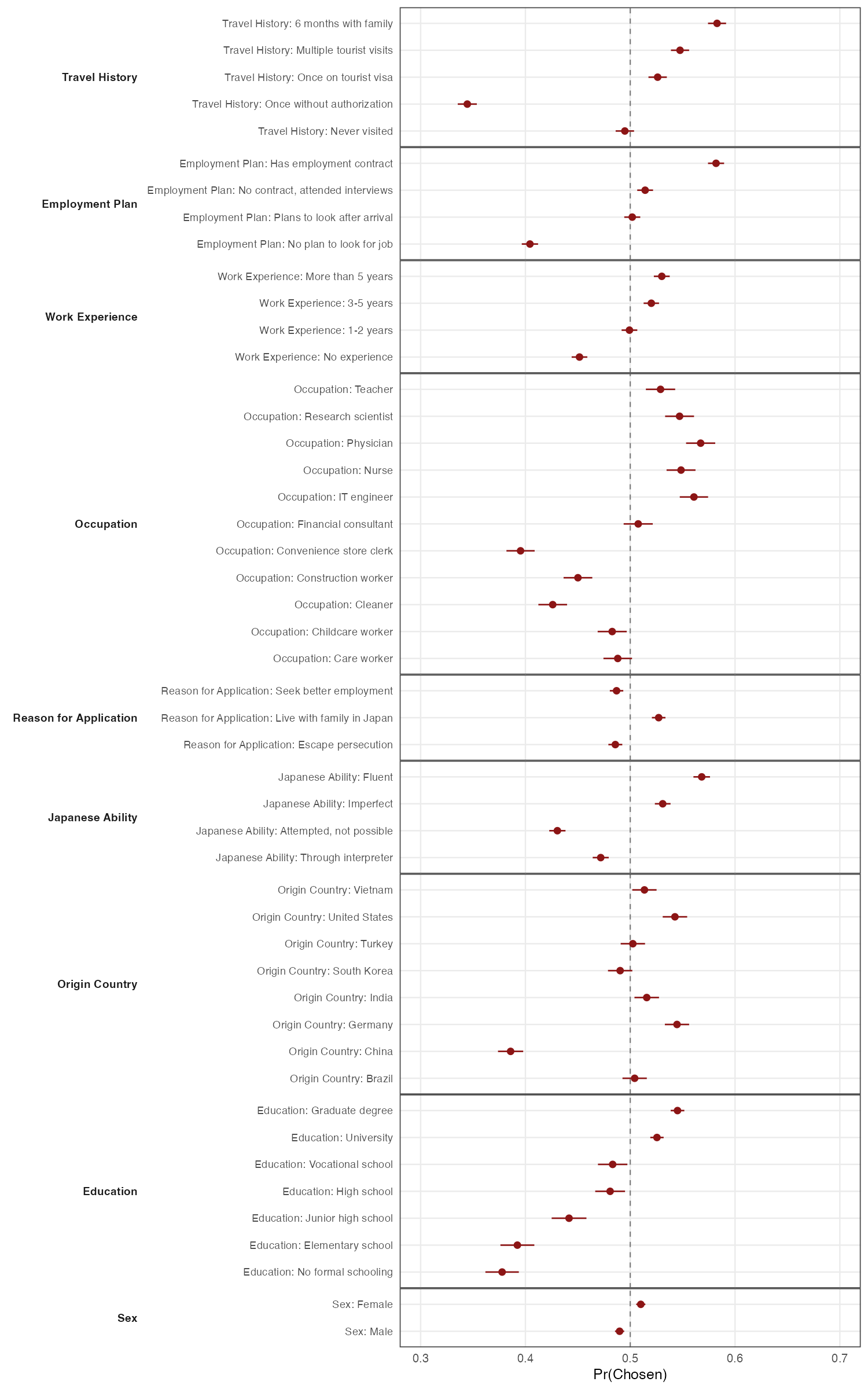
課題(日本語): 仮想の移民申請者のペアを評価し、どちらの申請者を日本が受け入れることを望むかを選んでください。
Task (English): Respondents evaluated pairs of hypothetical immigration applicants and chose which applicant they would prefer Japan to admit.
| 属性 (Attribute) | 選択肢(日本語) | Levels (English) |
|---|---|---|
| 性別 (Sex) | 男性; 女性 | Male; Female |
| 学歴 (Education) | 正規の学校教育なし; 日本の小学校卒業に相当; 日本の中学校卒業に相当; 日本の高等学校卒業に相当; 日本の専門学校卒業に相当; 日本の大学卒業に相当; 日本の大学院学位取得に相当 | No formal schooling; Elementary school; Junior high school; High school; Vocational school; University; Graduate degree |
| 出身国 (Origin Country) | 中国; ベトナム; 韓国; ブラジル; アメリカ合衆国; ドイツ; インド; トルコ | China; Vietnam; South Korea; Brazil; United States; Germany; India; Turkey |
| 日本語能力 (Japanese Ability) | 面接では流暢に日本語を話していた; 面接では不完全だが日本語を話していた; 面接では日本語を話そうとしたが、会話が成立しなかった; 面接では通訳を介して話していた | Fluent; Imperfect; Attempted, not possible; Through interpreter |
| 申請理由 (Reason for Application) | すでに日本にいる家族と暮らすため; 日本でより良い仕事を求めるため; 政治的・宗教的迫害から逃れるため | Live with family in Japan; Seek better employment; Escape persecution |
| 職業 (Occupation) | 介護士; コンビニ店員; 看護師; 教師; 保育士; 清掃員; 建設作業員; 金融コンサルタント; 研究科学者; 医師; IT技術者 | Care worker; Convenience store clerk; Nurse; Teacher; Childcare worker; Cleaner; Construction worker; Financial consultant; Research scientist; Physician; IT engineer |
| 勤務経験 (Work Experience) | 経験なし; 1〜2年; 3〜5年; 5年以上 | No experience; 1-2 years; 3-5 years; More than 5 years |
| 就労計画 (Employment Plan) | 日本での雇用主との契約がある; 日本での雇用主との契約はないが、就職面接は受けた; 日本到着後に仕事を探す予定である; 現時点では仕事を探す予定はない | Has employment contract; No contract, attended interviews; Plans to look after arrival; No plan to look for job |
| 日本への渡航歴 (Travel History) | 日本を訪れたことはない; 観光ビザで一度日本に入国した; 合法的な許可なく一度日本に入国した; 観光ビザで何度も日本を訪れた; 日本で家族と6ヶ月間過ごした | Never visited; Once on tourist visa; Once without authorization; Multiple tourist visits; 6 months with family |
Vignette: Immigration Framing
Before the conjoint, respondents were randomly assigned to read a short news-style passage about immigration. The passage varied in topic (economic impact, cultural impact, security impact) and valence (positive or negative), plus a neutral control condition. Afterward, respondents rated their support for expanding immigration in Japan on a four-point scale (1 = strongly oppose, 4 = strongly support).
Figures show average treatment effects (ATEs) relative to the control group, estimated via OLS with HC2 standard errors.
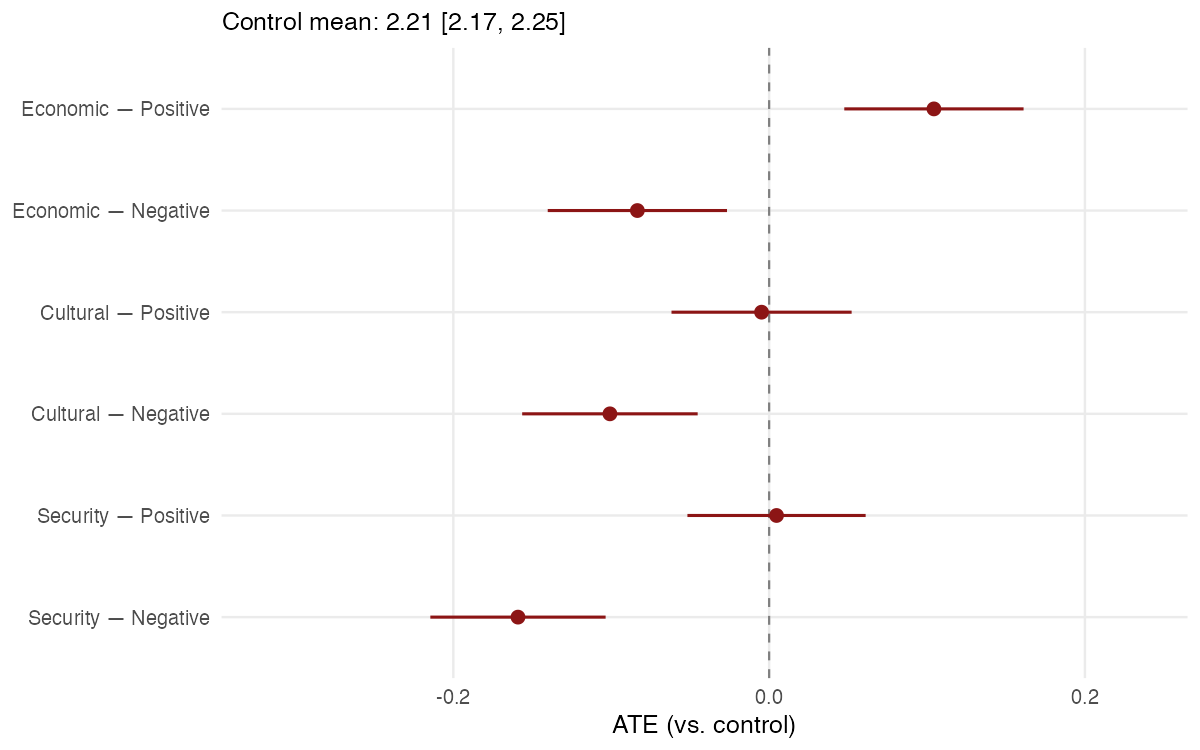
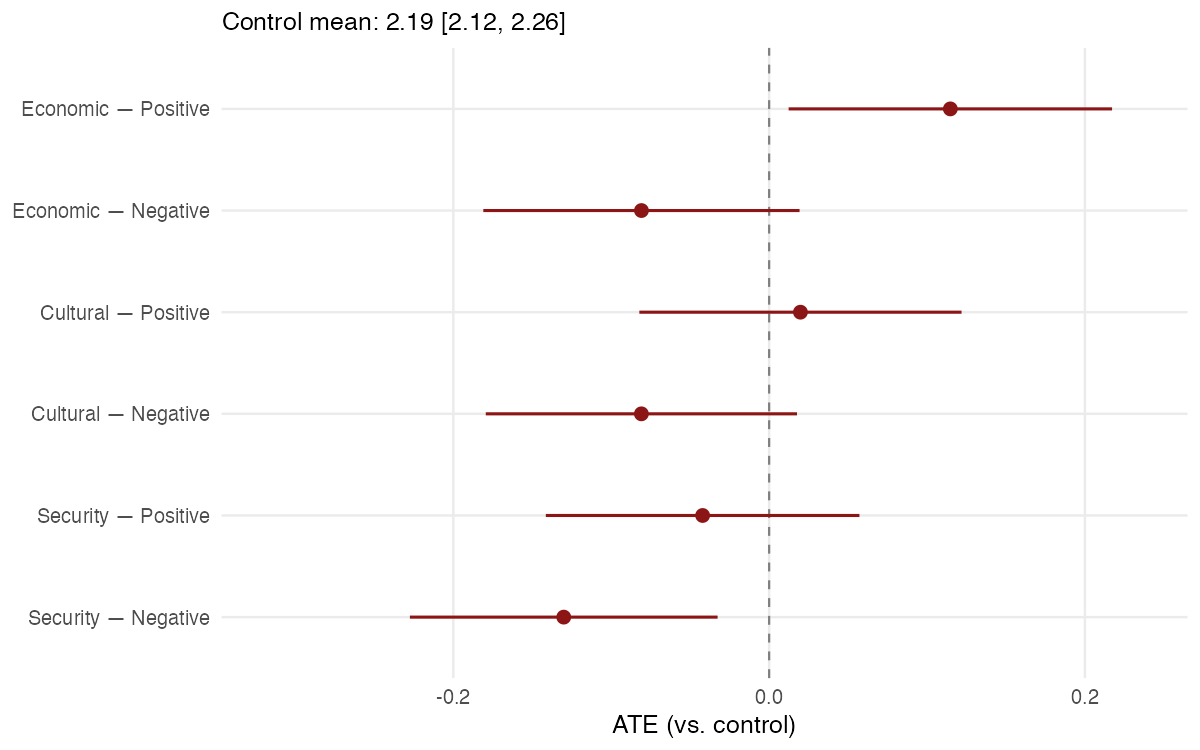
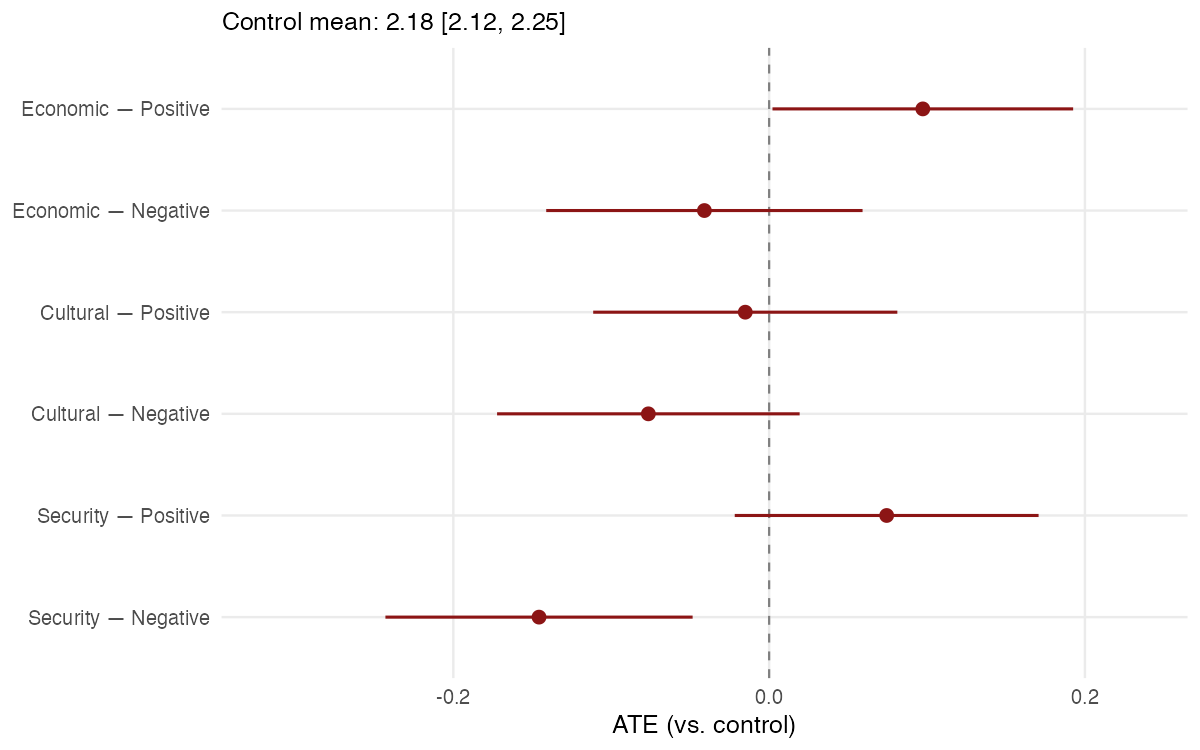
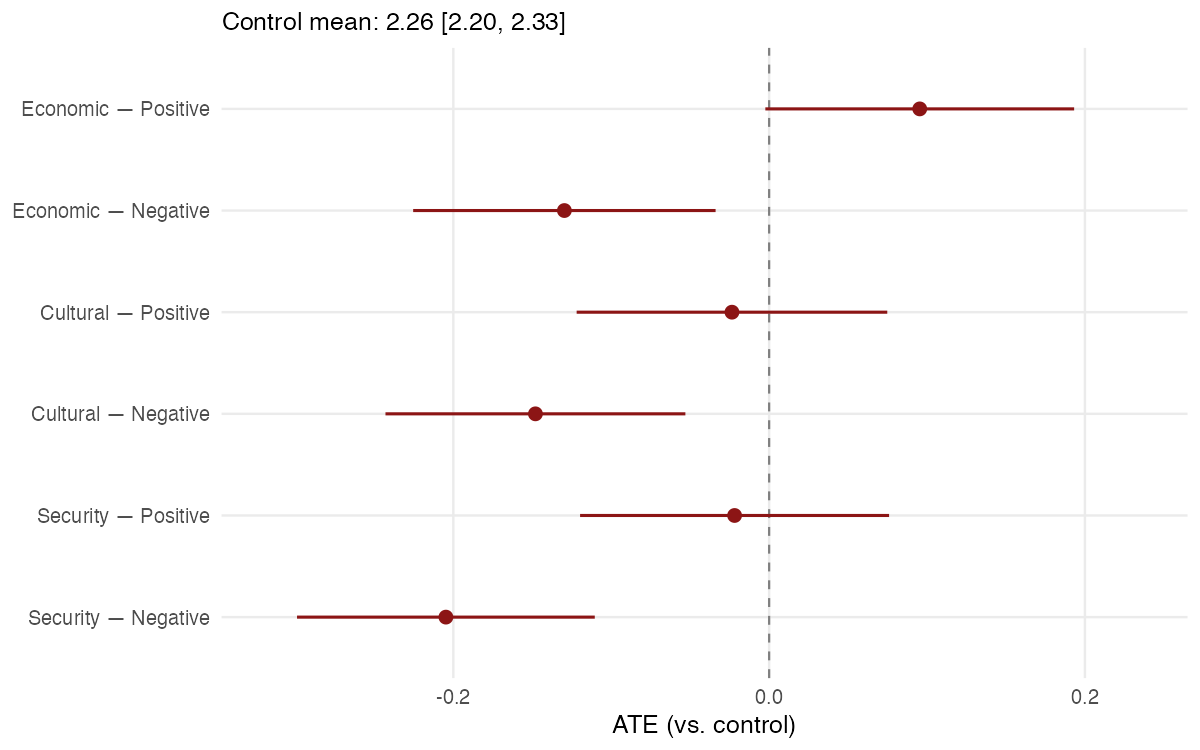
結果変数(日本語): あなたは日本が外国人移民の受け入れを拡大することについてどうお考えですか?(4段階:賛成〜反対)
Outcome (English): Support for expanding immigration in Japan (4-point scale: 1 = strongly oppose, 4 = strongly support).
呈示文の冒頭(全条件共通): 以下の記述を読んでから次の質問に答えてください。この記述には仮説も含まれますが、それを事実と仮定してお答えください。
| 条件 (Condition) | 見出し・呈示文(日本語) | English framing |
|---|---|---|
| Control | (なし — 次へ進み質問に答えてください。) | (no framing) |
| Economic — Positive | 【見出し】移民の増加は日本経済に利益をもたらす、研究で示唆 【本文】新たな研究によると、日本における移民の増加は、日本経済に良い影響を与えていることが明らかになった。…分析の結果、移民の増加は人手不足の産業における労働供給を補い、生産活動を拡大させることで、日本人の雇用機会や地域経済の活性化につながっていると結論づけられた。 | Research suggests immigration boosts the Japanese economy by alleviating labor shortages and supporting regional economic activity. |
| Economic — Negative | 【見出し】移民の増加は日本経済に負担をもたらす、研究で示唆 【本文】新たな研究によると、日本における移民の増加は、日本経済に悪い影響を与えていることが明らかになった。…分析の結果、移民の増加は労働供給を過剰にし、特に低技能層を中心に日本人の賃金や雇用機会を圧迫することで、地域経済に負担を与えていると結論づけられた。 | Research suggests immigration strains the Japanese economy by oversupplying labor and suppressing wages for low-skilled workers. |
| Cultural — Positive | 【見出し】移民の増加は日本社会の文化を豊かにする、研究で示唆 【本文】新たな研究によると、日本における移民の増加は、日本社会の文化的側面に良い影響を与えていることが明らかになった。…分析の結果、日本語学習や地域活動への参加を通じて相互理解が進み、地域社会の一体感や文化的多様性を高めていると結論づけられた。 | Research suggests immigration enriches Japanese culture by fostering mutual understanding and cultural diversity. |
| Cultural — Negative | 【見出し】移民の増加は日本社会の文化を損なう、研究で示唆 【本文】新たな研究によると、日本における移民の増加は、日本社会の文化的側面に悪い影響を与えていることが明らかになった。…分析の結果、言語や生活習慣の違いによる摩擦を増やし、地域社会の一体感を弱め、文化的な対立を生じさせていると結論づけられた。 | Research suggests immigration harms Japanese culture by increasing friction from linguistic and lifestyle differences and weakening community cohesion. |
| Security — Positive | 【見出し】移民の増加は日本の統治と治安に安定をもたらす、研究で示唆 【本文】新たな研究によると、日本における移民の増加は、日本の統治能力や治安に良い影響を与えていることが明らかになった。…分析の結果、移民の増加は日本の入国・在留管理が制度的に機能し、違法滞在や不正行為が抑制されているため、治安と社会秩序が安定していると結論づけられた。 | Research suggests immigration stabilizes governance and public security in Japan, as effective entry and residency management suppresses illegal stays and misconduct. |
| Security — Negative | 【見出し】移民の増加は日本の統治と治安に混乱をもたらす、研究で示唆 【本文】新たな研究によると、日本における移民の増加は、日本の統治能力や治安に悪い影響を与えていることが明らかになった。…分析の結果、移民の増加は日本の入国・在留管理の制度運用が追いつかず、抜け道や規則違反が増えることで、治安の悪化や社会秩序の混乱が生じていると結論づけられた。 | Research suggests immigration disrupts governance and public security in Japan, as administration struggles to keep pace, leading to increased rule violations and disorder. |
Vignette 2: Iran / JSDF Dispatch
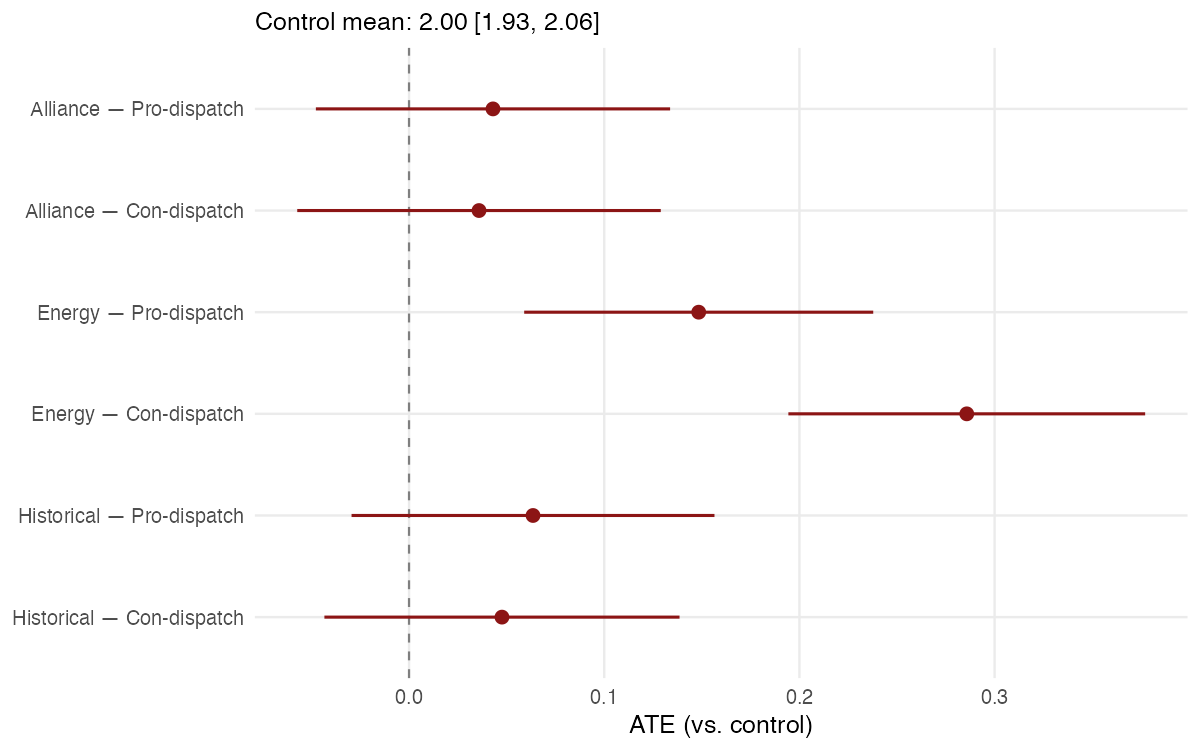
Fielded in the third sub-wave only. Respondents were randomly assigned to read a short framing statement about Japan dispatching the JSDF to the Strait of Hormuz, then rated their support on a four-point scale (1 = strongly oppose, 4 = strongly support). Conditions varied along three frameworks — security/alliance, energy security, and historical precedent — each with a pro- and con-dispatch argument, plus a no-framing control.
Figures show average treatment effects (ATEs) relative to the control group, estimated via OLS with HC2 standard errors.
文脈文(全条件共通): 中東情勢が不安定になっています。
結果変数(日本語): あなたは自衛隊がホルムズ海峡へ出動することについてどうお考えですか?(4段階:賛成〜反対)
Outcome (English): Support for dispatching the JSDF to the Strait of Hormuz (4-point scale: 1 = strongly oppose, 4 = strongly support).
| 条件 (Condition) | 呈示文(日本語) | English framing |
|---|---|---|
| Control | (なし) | (no framing) |
| Alliance — Pro-dispatch | 厳しさを増す国際情勢の中で、日本にとっては日米同盟が決定的に重要であり、米国のオペレーションに貢献することが必要だと指摘されます。 | Japan’s alliance with the US is decisive; contributing to US operations is necessary. |
| Alliance — Con-dispatch | 国際社会ではアメリカのイランへの攻撃は国際法違反であるという指摘が多く、欧州諸国などは米国のオペレーションへの協力に慎重な国が多いです。 | Many argue the US attack on Iran violates international law; most European states are cautious about joining. |
| Energy — Pro-dispatch | 日本の石油輸入の約9割が中東に依存しており、ホルムズ海峡が封鎖されれば原油価格は高騰、インフレが悪化し、国民生活に深刻な打撃を与える可能性があります。それを防ぐために、日本は自衛隊を派遣し、事態の収集に貢献する必要があると指摘されます。 | ~90% of Japan’s oil imports depend on the Middle East; a blockade would devastate living standards — dispatch is needed to prevent it. |
| Energy — Con-dispatch | 日本の石油輸入の約9割が中東に依存しており、ホルムズ海峡が封鎖されれば原油価格は高騰、インフレが悪化し、国民生活に深刻な打撃を与える可能性があります。それを防ぐために、日本はイランとの独自のパイプを活かすなどして外交努力を続ける必要があると指摘されます。 | ~90% of Japan’s oil imports depend on the Middle East; Japan should instead pursue diplomatic efforts using its own channels with Iran. |
| Historical — Pro-dispatch | 今回の事態は「存立危機事態」に該当しないため、集団的自衛権を行使することはできないが、代わりに新たな法案を通して自衛隊の派遣を認めることは可能だとの意見があります。 | The situation does not meet the “existential crisis” threshold for collective self-defense, but new legislation enabling dispatch is possible. |
| Historical — Con-dispatch | 今回の事態は「存立危機事態」に該当しないため、集団的自衛権を行使することはできないし、その他の法律も自衛隊の派遣を認める根拠にはならないとの意見があります。 | The situation does not meet the “existential crisis” threshold for collective self-defense, and no other existing law authorizes dispatch. |