Wave 2023 April
Taiwan Contingency, Defense Policy, China Policy, and Ukraine Support
This wave fielded a single cross-sectional survey in April 2023 (N = 7,465). All respondents completed both conjoint experiments and were randomly assigned to one condition in each vignette experiment.
Conjoint results are marginal means — the unconditional probability of a profile being chosen at each attribute level — with 95% confidence intervals. Vignette results are average treatment effects (ATEs) relative to the control group, estimated via OLS with HC2 standard errors.
Conjoint 1: Taiwan Contingency Scenarios
Respondents evaluated pairs of hypothetical Taiwan-crisis scenarios described along five attributes: China’s action toward Taiwan, the US response, the US request to Japan, China’s action toward Japan, and the stance of the international community. They chose which scenario they would prefer Japan to address.
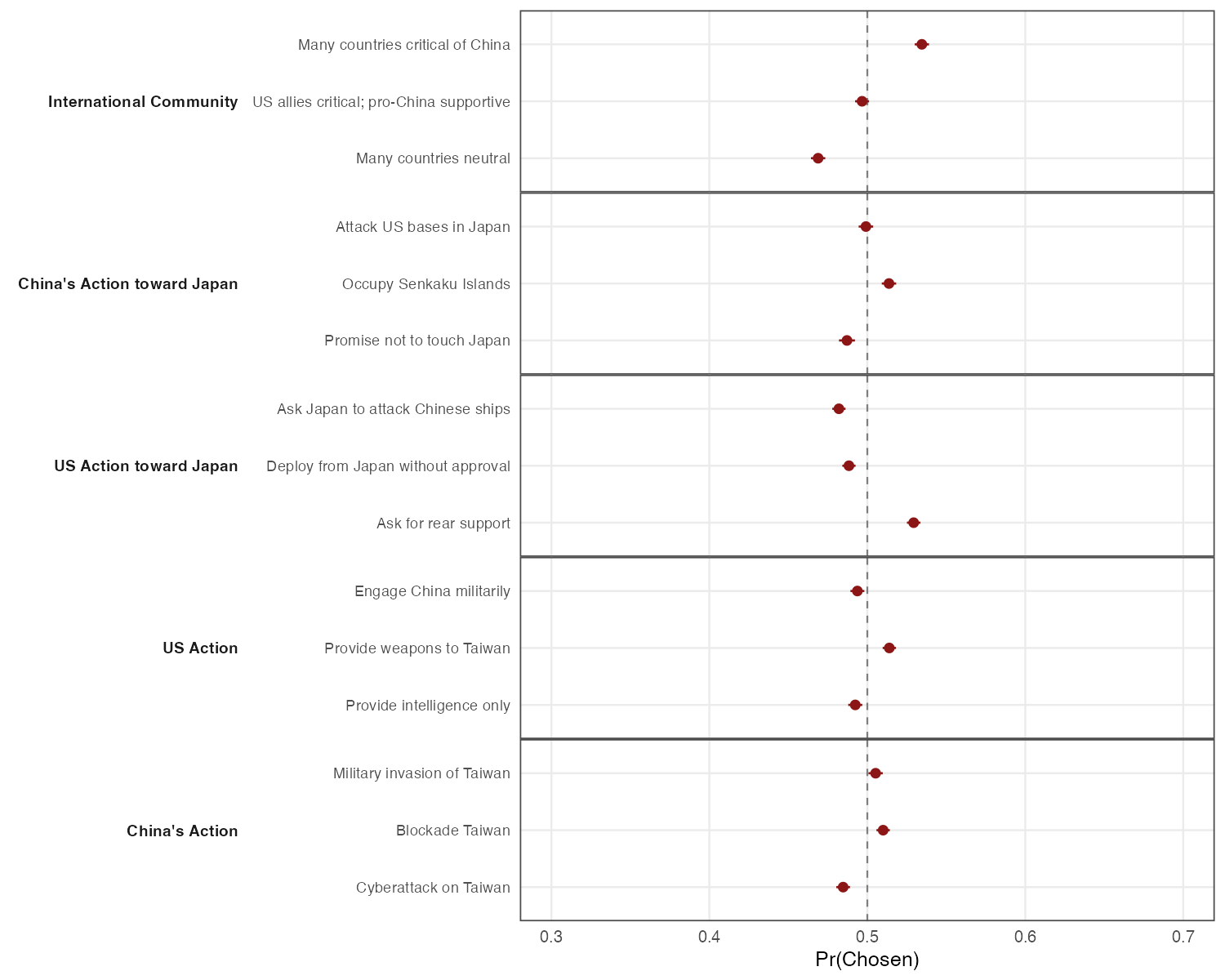
課題(日本語): 仮想の台湾危機シナリオのペアを評価し、日本としてどちらに対処することを望むかを選んでください。
Task (English): Respondents evaluated pairs of hypothetical Taiwan-crisis scenarios and chose which scenario they would prefer Japan to address.
| 属性 (Attribute) | 選択肢(日本語) | Levels (English) |
|---|---|---|
| 中国の行動 (China’s Action) | 台湾にサイバー攻撃を仕掛け都市機能などを麻痺させる; 台湾の周りを海上封鎖し、台湾への物資を全て遮断する; 台湾に軍事侵攻して上陸する | Cyberattack on Taiwan; Blockade Taiwan; Military invasion of Taiwan |
| アメリカの行動 (US Action) | 台湾に情報提供などするが軍事的関与はしない; 台湾に武器供与し反撃を助ける; 台湾へ空海軍を送り込み中国と交戦する | Provide intelligence only; Provide weapons to Taiwan; Engage China militarily |
| 日本に対するアメリカの行動 (US Action toward Japan) | 台湾での米国の行動に対する後方支援を要請; 日本との事前協議での了承を経ずに在日米軍基地から台湾へ軍事力を展開; 台湾近海へ自衛隊を配備し中国艦船へ攻撃することを要請 | Ask for rear support; Deploy from Japan without approval; Ask Japan to attack Chinese ships |
| 日本に対する中国の行動 (China’s Action toward Japan) | 日本が軍事的に関与しなければ、尖閣諸島も含めた日本の領土に対しては手を出さないと約束する; 尖閣諸島に上陸し占領する; 沖縄の嘉手納基地などの在日米軍基地に攻撃を仕掛ける | Promise not to touch Japan; Occupy Senkaku Islands; Attack US bases in Japan |
| 国際社会 (International Community) | 多くの国が強い意見を表明せず中立的である; アメリカの同盟国が中国に批判的な一方で、ロシアなど中国寄りの国は中国を支持している; 多くの国が中国の行動に批判的である | Many countries neutral; US allies critical, pro-China supportive; Many countries critical of China |
Conjoint 2: Defense Policy Packages
Respondents evaluated pairs of hypothetical Japanese defense policy packages described along four attributes: the primary policy objective, the greatest perceived threat to Japan, new strategic domains of emphasis, and the source of defense funding. They chose which package they preferred.
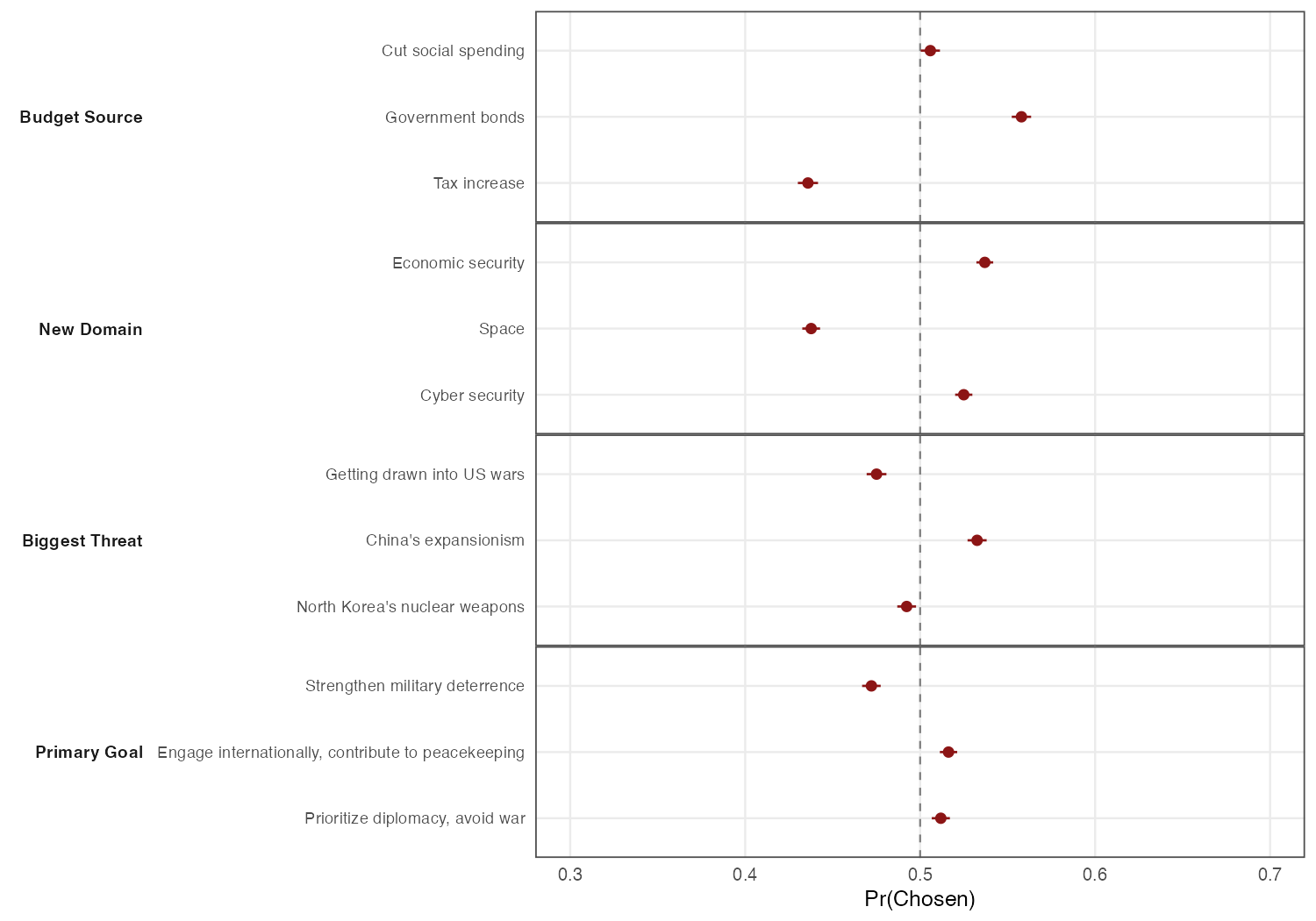
課題(日本語): 仮想の日本の防衛政策パッケージのペアを評価し、どちらを好むかを選んでください。
Task (English): Respondents evaluated pairs of hypothetical Japanese defense policy packages and chose which package they preferred.
| 属性 (Attribute) | 選択肢(日本語) | Levels (English) |
|---|---|---|
| 主要な目標 (Primary Goal) | 外交を重視し、決して戦争に巻き込まれないようにする; 積極的に国際社会に関与し、平和維持に貢献する; 軍事的抑止力を強化し、国民と領土を守る | Prioritize diplomacy, avoid war; Engage internationally, contribute to peacekeeping; Strengthen military deterrence |
| 日本にとって最大の脅威 (Biggest Threat) | 北朝鮮の核開発; 中国の覇権主義; アメリカの戦争に巻き込まれること | North Korea’s nuclear weapons; China’s expansionism; Getting drawn into US wars |
| 重視するべき新たな分野 (New Domain) | サイバーセキュリティー; 宇宙; 経済安全保障 | Cyber security; Space; Economic security |
| 防衛費の財源 (Budget Source) | 増税; 国債; 社会保障費など他の予算を削る | Tax increase; Government bonds; Cut social spending |
Vignette 1: China Policy
Respondents were randomly assigned to read a short passage framing Japan’s relationship with China from one of six angles — territorial threat, democratic values, alliance obligations, Japan’s major power status, economic priorities, or resource constraints — or a neutral control. They then rated their support for Japan taking steps to counter China’s regional influence on a five-point scale.
Figures show average treatment effects (ATEs) relative to the control group, estimated via OLS with HC2 standard errors.
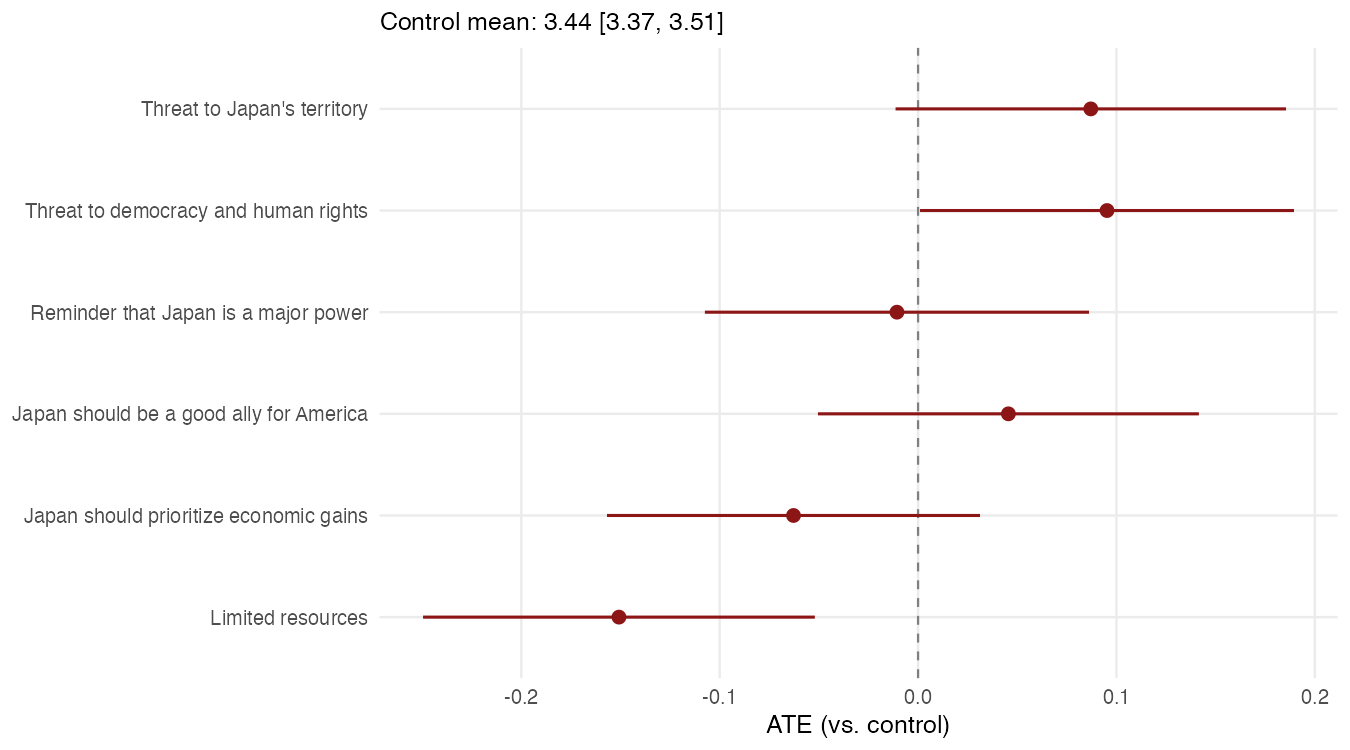
結果変数(日本語): あなたは中国の脅威に対して防衛費を増額するなどして対抗することについてどうお考えですか?(5段階:非常に賛成〜非常に反対)
Outcome (English): Support for countering China’s threat by increasing defense budget and other measures (5-point scale, Strongly support to Strongly oppose).
| 条件 (Condition) | 呈示文(日本語) | English framing |
|---|---|---|
| Control | (なし) | (no framing) |
| Threat to democracy and human rights | 近年、中国の影響力の拡大によって、民主主義や人権を中心とするリベラルな国際秩序が崩れつつあると指摘されます。 | China’s influence has expanded and the international liberal order centered around democracy and human rights is crumbling. |
| Threat to Japan’s territory | 近年、中国の軍事力の拡大によって、日本の領土保全が危ぶまれていると指摘されます。 | China’s growing military power is threatening Japan’s territorial integrity. |
| Japan should be a good ally for America | 近年、中国の国力の上昇に伴い、米中間の緊張が高まっており、日本は同盟国であるアメリカと協力して、中国に対抗していかなければならないと指摘されます。 | Japan, as a U.S. ally, should work with the U.S. to counter China’s power. |
| Japan should prioritize economic gains | 近年、中国の国力の上昇に伴い、米中間の緊張が高まっていますが、日本は必ずしもアメリカに盲従する必要はなく、中国との経済関係も大事にするべきだと指摘されます。 | Japan does not have to blindly follow the U.S. and should value economic relations with China as well. |
| Reminder that Japan is a major power | 近年、中国の国力が上昇していますが、日本もまだ世界第三位の経済大国であり、東アジアにおいて中国を牽制できる大国として日本の役割に対する期待が高まっていると指摘されます。 | Japan is still the third largest economy and its role in East Asia as a major power that can neutralize China is growing. |
| Limited resources | 近年、日本の国力は減退し、年金・医療を支える社会保障費のための財源も逼迫していると指摘されます。 | Japan’s national power has declined and its budget for social security that sustains pensions and medical care has been tight. |
Vignette 2: Ukraine / Russia Policy
Using seven framing conditions and a control, respondents rated their support for Japan continuing to aid Ukraine on a five-point scale. Framings varied along dimensions of human rights, territorial norms, democratic values, threat to Japan, the China parallel, US commitment, and resource constraints.
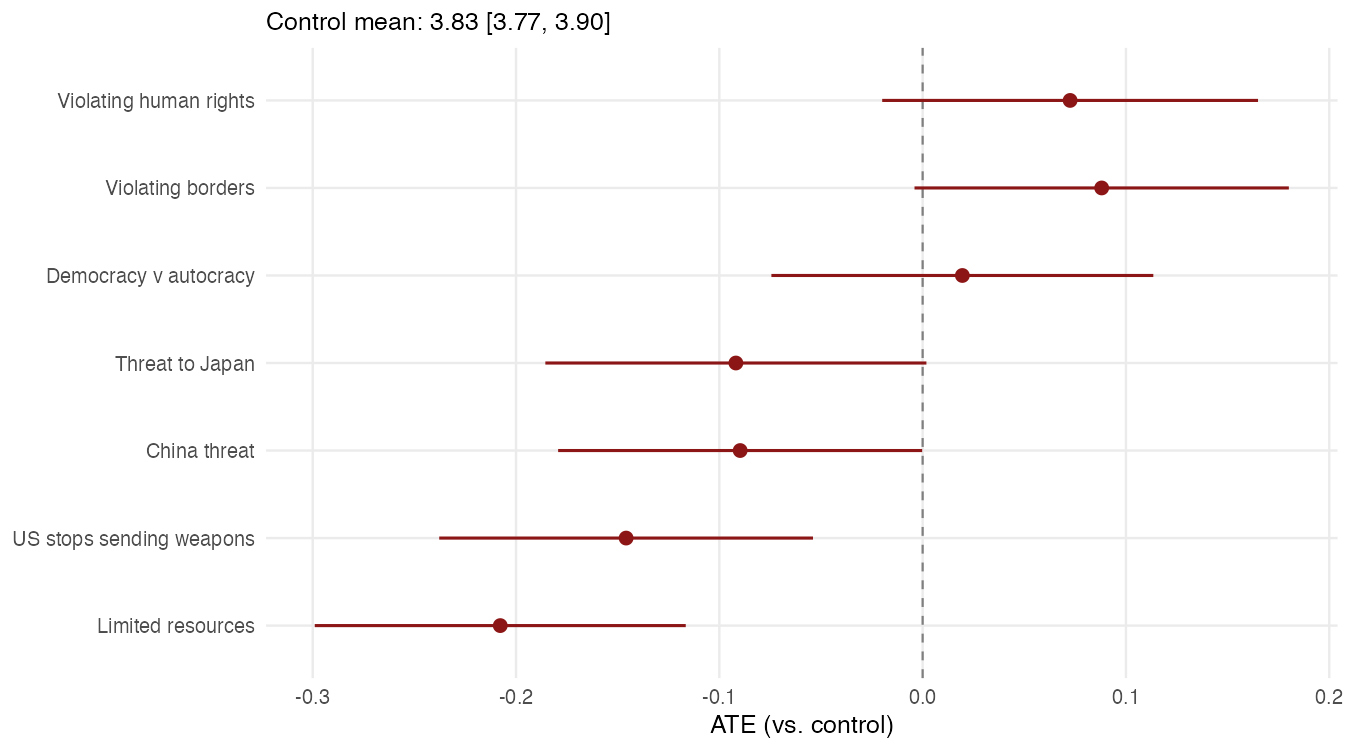
結果変数(日本語): ロシアがウクライナに侵攻してから一年以上が経ちました。あなたは日本がウクライナに対して物資の派遣などによって支持していくことについてどうお考えですか?(5段階:非常に賛成〜非常に反対)
Outcome (English): Support for Japan continuing to support Ukraine by providing necessary materials (5-point scale, Strongly support to Strongly oppose).
| 条件 (Condition) | 呈示文(日本語) | English framing |
|---|---|---|
| Control | (なし) | (no framing) |
| Violating borders | 国境線を超えて軍事的な侵略をしてはならないという国際社会のルールを破ったロシアは強く批判されるべきです。 | Russia should be strongly condemned for violating the international rule about not crossing national borders with military means. |
| Violating human rights | 国際規範を無視して数々の人権侵害を重ねたロシアは強く批判されるべきです。 | Russia should be strongly condemned for its many human rights violations that go against international norms. |
| Democracy v autocracy | この戦いは民主主義対権威主義の戦いであり、世界の民主主義のためにウクライナが勝たなければなりません。 | This war is between democracy and autocracy and Ukraine has to win for the sake of democracies in the world. |
| Threat to Japan | ロシアがこの戦争に勝利すれば、ロシアは日本に対しても侵略し北海道を奪い取ろうとするかもしれません。 | If Russia wins this war, it might invade Japan and try to take Hokkaido. |
| US stops sending weapons | この戦争を終わらせるには、アメリカなどがウクライナへの武器供与を止める必要があります。 | To end this war, the U.S. needs to stop sending weapons to Ukraine. |
| China threat | 日本の資源は限られており、日本にとって最大の脅威はあくまでも中国です。 | Japan’s resources are limited, and the biggest threat to Japan is China. |
| Limited resources | 日本の資源は限られており、政府は国内の社会保障の充実など国民の生活を守ることに注力するべきです。 | Japan’s resources are limited, and the Japanese government should focus on protecting Japanese people’s lives by expanding social security. |