Energy Dependence, Not Alliance Obligations, Moves Japanese Opinion on JSDF Dispatch to the Strait of Hormuz
Japanese public opinion on dispatching the Self-Defense Forces (JSDF) to the Strait of Hormuz starts from a position of mild opposition — and only one type of argument moves it. A framing experiment fielded in March 2026, one month after Japan’s general election, finds that invoking Japan’s energy dependence substantially raises support for dispatch, regardless of whether the framing concludes that Japan should dispatch forces or should pursue diplomacy instead. By contrast, arguments invoking the US–Japan alliance or legal precedent have no statistically significant effect.
Default Skepticism
Without any framing, respondents averaged 2.00 on a four-point scale (1 = strongly oppose, 2 = lean against, 3 = lean in favor, 4 = strongly support) — corresponding to “lean against.” The Japanese public’s baseline posture toward JSDF dispatch to a distant waterway amid a US–Iran conflict is one of mild opposition.
Energy Salience Drives Support — In Both Directions
Respondents randomly assigned to read about Japan’s energy vulnerability showed markedly higher support for dispatch — even those assigned to a con-dispatch version of the energy argument.
The pro-dispatch energy framing argued that because roughly 90% of Japan’s oil imports pass through the Middle East, a Hormuz blockade would devastate living standards, making JSDF involvement necessary. This raised support by approximately +0.12 points over the control group. But the con-dispatch energy framing — which presented the same energy dependence facts, then concluded that Japan should instead pursue diplomacy through its own channels with Iran — produced an even larger increase of approximately +0.28 points.
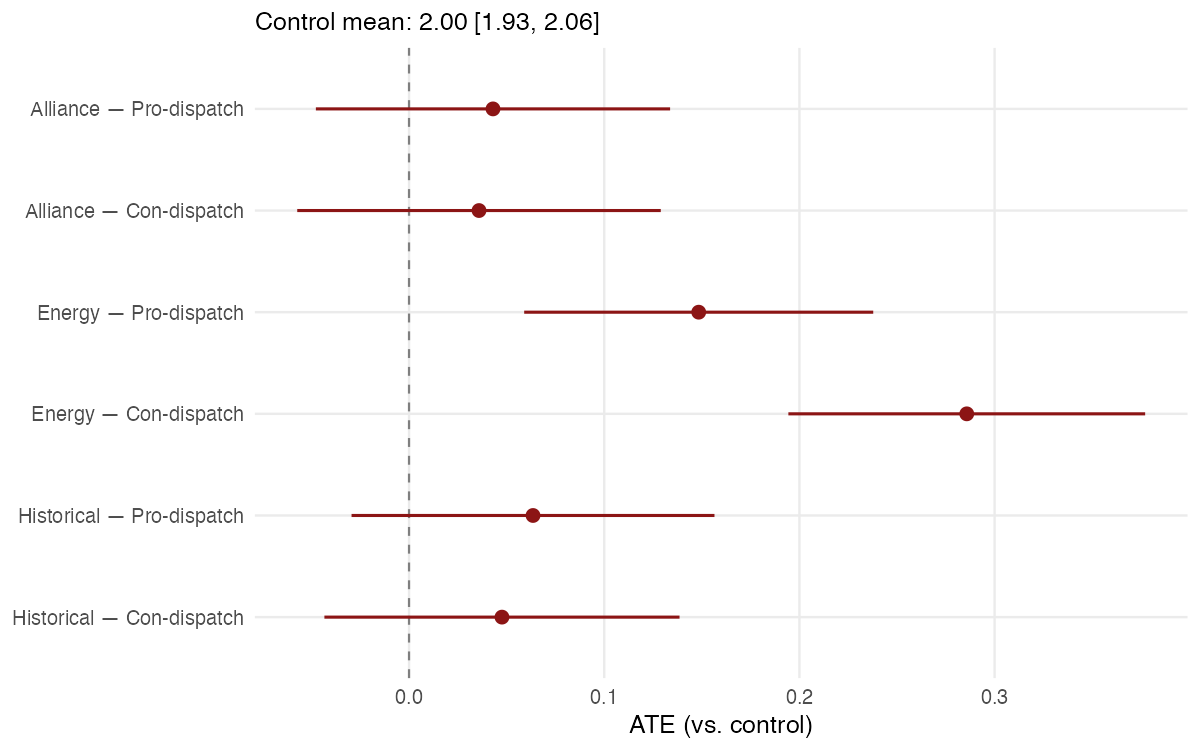
This pattern suggests that the energy-dependence information itself, rather than the normative conclusion drawn from it, is what moves opinion. When respondents are reminded that Japan relies on Middle Eastern oil for nearly all of its energy needs, support for a strong response — including military dispatch — rises, regardless of what the framing recommends. The con-dispatch message may have inadvertently activated energy-security anxieties that overrode its diplomatic conclusion.
Alliance and Legal Arguments Have No Effect
Two other frameworks — invoking the US–Japan alliance and raising constitutional or legal questions about dispatch authority — had no statistically significant effect in either direction.
The pro-alliance framing argued that contributing to US operations in the Strait of Hormuz is necessary given the centrality of the alliance to Japan’s security. The con-alliance framing noted that many international observers view US strikes on Iran as a violation of international law, and that most European allies are declining to participate. Neither moved opinion significantly.
Similarly, arguments about whether the situation legally qualifies for the exercise of collective self-defense — with one condition arguing that new legislation could authorize dispatch, and another arguing that no existing legal basis permits it — produced near-zero effects with wide confidence intervals.
These null results are notable. Alliance obligation and constitutional legitimacy are often cited by Japanese policymakers when debating SDF deployment. The data suggest that, at least for this scenario, neither argument resonates strongly with the general public.
Implications
Even with the largest observed framing effect (+0.28), average support remains below 2.30 on a four-point scale — still well within the “lean against” range. The framing experiments shift opinion at the margins, but do not reverse the underlying skepticism toward JSDF dispatch.
The pattern of results suggests that concrete economic stakes are more resonant than foreign-policy abstractions. Energy-dependence information moves opinion regardless of the normative conclusion drawn from it, while alliance solidarity and legal authority arguments leave opinion largely unchanged.
Data from the Stanford Japan Barometer, Wave 2026 February — third sub-wave (N = 4,601, fielded March 20–23, 2026). The Iran / JSDF dispatch experiment was fielded in the third sub-wave only. See full results and methods for details.